
Articulated Fume Extraction Duct Arm: 360° Fume Capture Guide
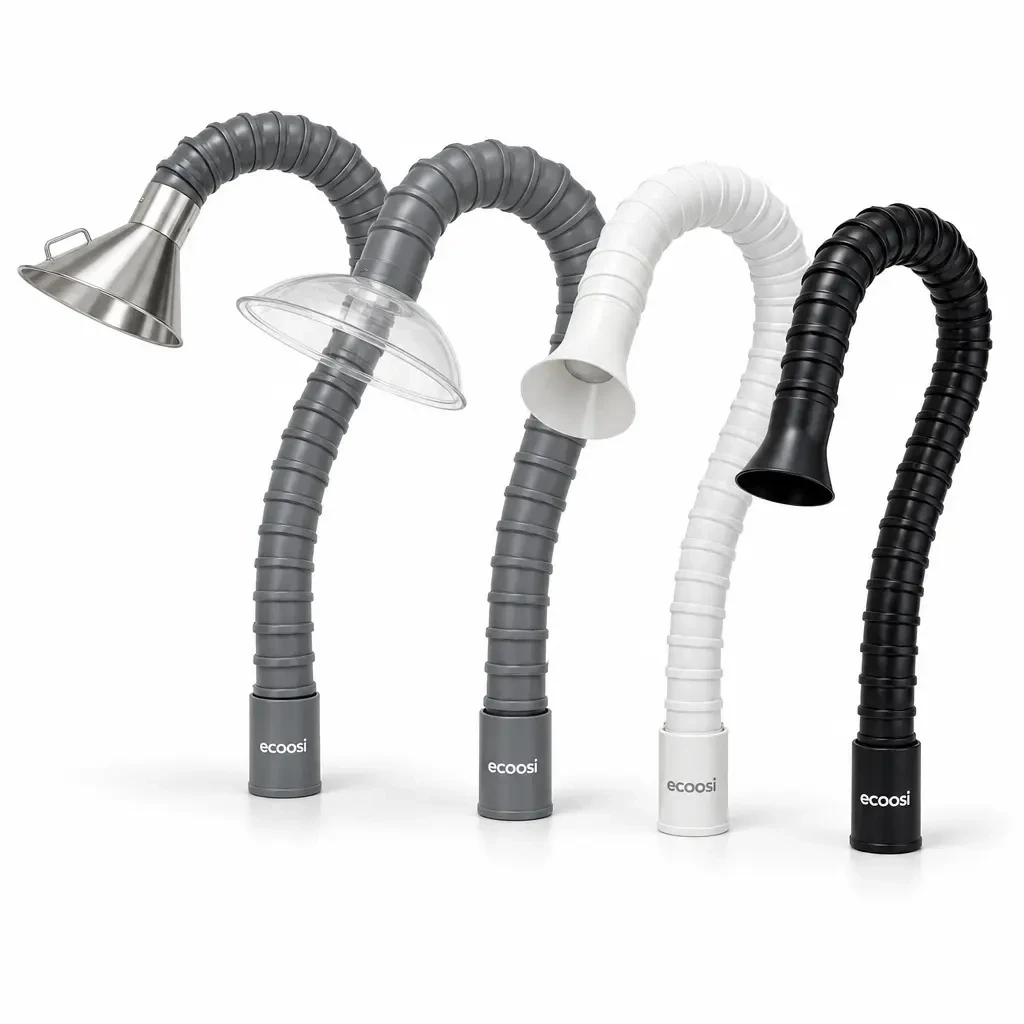
Ecoosi articulated fume extraction duct arms hold their own position through a full 360 degrees without external support, capturing welding, laser and soldering smoke at the source. Available in 50-200 mm bores, rated to 130 °C, with interchangeable hoods and an integrated damper.
What Is an Articulated Fume Extraction Duct Arm?
An articulated fume extraction duct arm is a segmented, bendable hose assembly that holds its own position at any angle and draws welding smoke, laser cutting fumes, solder flux vapor and fine dust away from the source. Because the arm is self-supporting, it needs no ceiling bracket, counterweight or external support to stay where the operator places it: bend it once, and it holds.
Typical users include assembly-line soldering stations, electronics laboratories and repair benches, laser engraving and cutting machines, wave soldering and solder pot lines, spray coating booths, and general workshop exhaust points.
Structure: Universal 360° Positioning Without External Support
The arm combines a universal, bendable segment stack with a flared nozzle and a fume extraction hood supplied as standard. It can be rotated through a full 360° and set at any angle within the working envelope, so the suction inlet can be aimed at the smoke source from any direction instead of being limited by the layout of the bench.
The articulated segments and the sealing rings between them form an airtight column that limits air infiltration along the duct. In combination with a correctly sized extractor, this helps maintain steady negative pressure at the hood and keeps capture performance consistent over longer runs.
Six Core Advantages
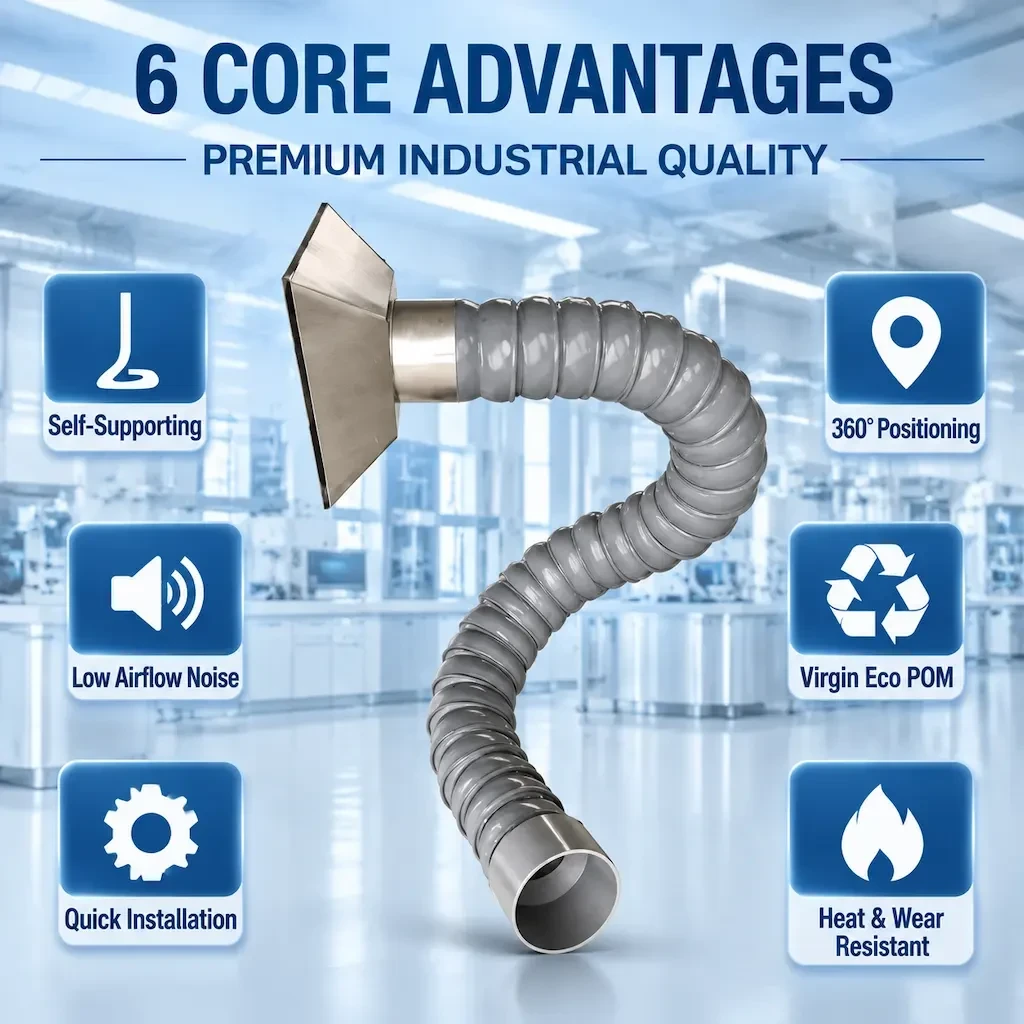
Self-supporting: the segment stack holds the set position, so no extra support hardware is needed for everyday use. 360° positioning: the hood can be aimed freely around the work area. Low airflow noise: smooth internal geometry keeps whistling and turbulence noise down in shared workspaces. Virgin POM construction: parts are moulded from virgin polyoxymethylene rather than recycled blends. Quick installation: the arm mounts to a bench, machine or extraction port with a simple connection. Heat and wear resistant: the reinforced wall keeps its shape and resists sagging and deformation in long-term use.
Material and Heat Resistance
The duct body is moulded from POM (polyoxymethylene), a rigid engineering thermoplastic chosen for its dimensional stability, low friction and resistance to wear. The completed assembly is rated for working temperatures up to 130 °C, which covers hot air from soldering irons, laser engraving and cutting machines, and most electronics and light industrial processes.
The front suction hood is made from high-temperature resistant material so it can be brought close to a heat-generating source for point-of-origin extraction, while the reinforced structural design of the hose helps it keep its shape and resist sagging even after long-term use.
Manual Damper: Suction Control at the Workstation
A manual damper is integrated into the arm. Operators can regulate suction volume according to the task, from delicate precision soldering to high-power laser work, without changing the extractor setting or leaving the bench. This gives each workstation direct control over its own airflow.
Hood Options for Different Capture Tasks
Because capture geometry often decides whether fumes enter the duct or the breathing zone, the arm is modular. Hoods change over in minutes with custom matching, allowing one arm design to serve soldering benches, welding points, laser tables and wide workshop exhaust positions:
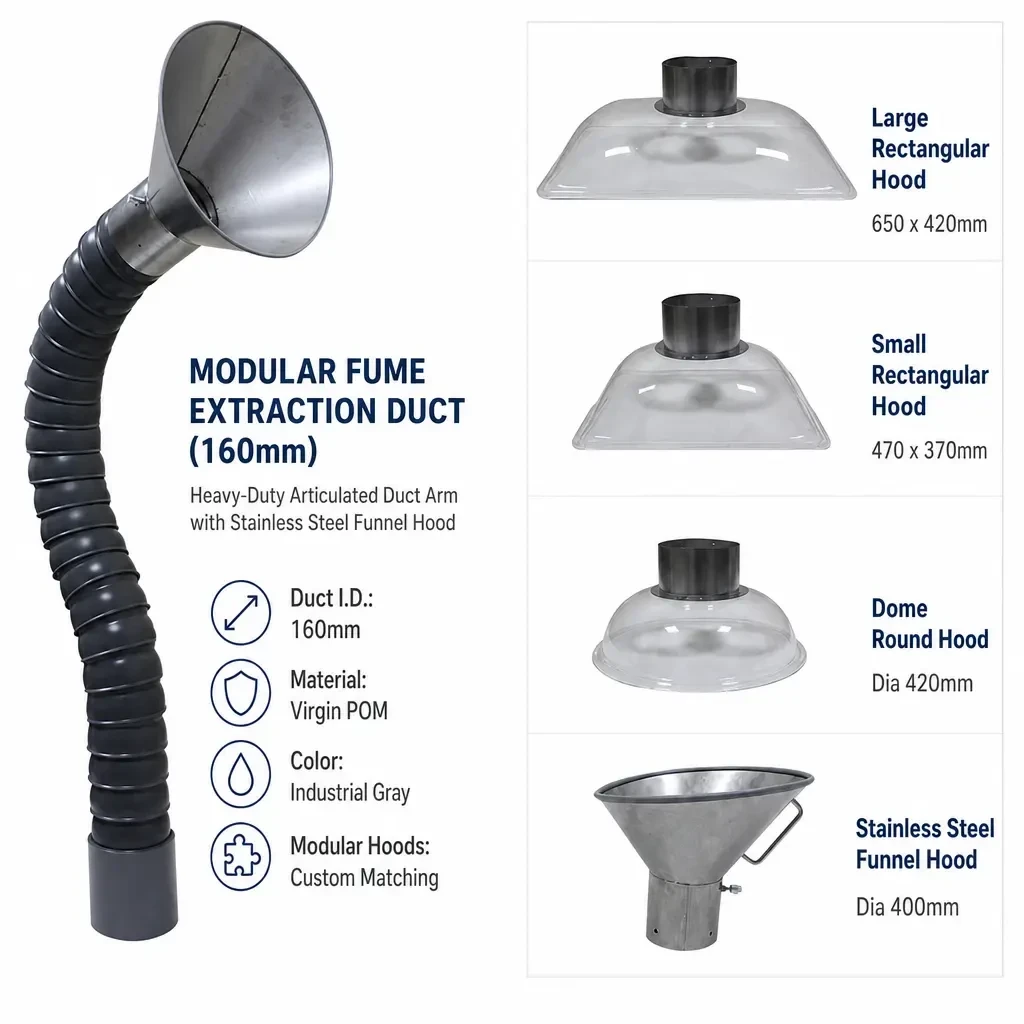
- Stainless steel funnel hood, 400 mm diameter - directional capture with high-temperature resistance, supplied on the standard 160 mm arm.
- Large rectangular hood, 650 x 420 mm - wide capture area for benches and work cells.
- Small rectangular hood, 470 x 370 mm - a compact rectangular option for tighter benches and laser tables.
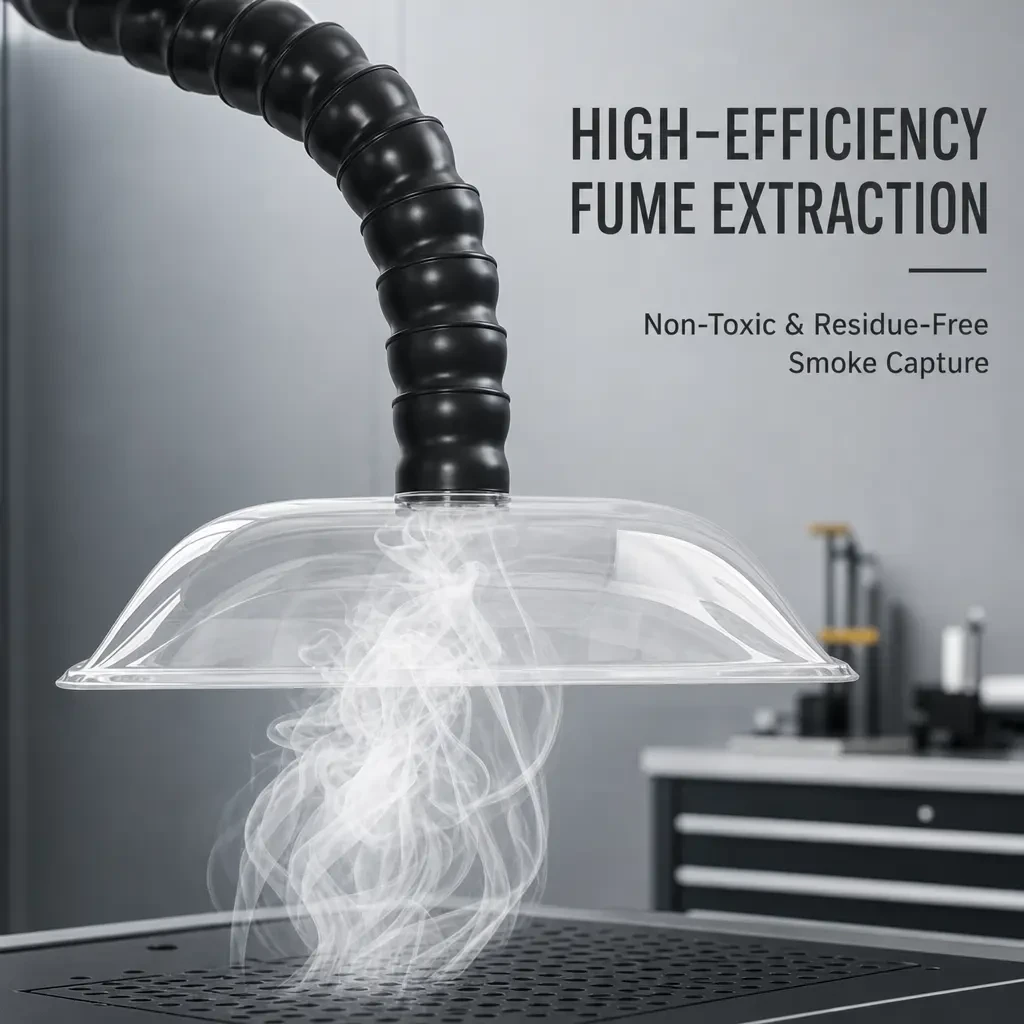
- Dome round hood, 420 mm diameter - a clear dome that lets operators watch smoke being captured in real time.
Specifications and Size Range
Arms are available with inner diameters of 50, 75, 110, 160 and 200 mm, and hose length is made to order, so the arm can be matched to both the airflow of the extractor and the physical reach of the workstation. The range offers a practical balance between flexibility and sealing performance: smaller bores suit precision soldering and laser benches, while larger bores handle welding fume, dust and higher-volume workshop exhaust.
The 160 mm modular arm shown above uses an industrial gray finish, virgin POM duct material and interchangeable hoods.
Where the Arm Performs Best
Common applications include:
- Assembly-line soldering and rework stations - capture flux and solder smoke at the joint.
- Laser cutting and laser engraving - extract fine smoke and particulate before it spreads.
- Electric welding and automated welding cells - remove welding fume from the breathing zone.
- Solder pots and wave soldering machines - handle continuous process fumes.
- Spray coating and local exhaust in workshops - extract overspray and solvent vapor at the point of generation.
- Electronics manufacturing and laboratories - keep benches and work areas free of airborne contamination.
- Targeted exhaust and light dust removal - a flexible alternative to fixed duct runs in confined or changing layouts.
- Moxibustion and other therapy smoke capture - quiet, adjustable extraction close to the treatment area.

Installation and System Integration
The arm mounts directly to a bench edge, machine frame or extraction trunk with a simple connection, and the integrated damper lets each station balance its own airflow. For multi-station workshops, several arms can share a central fan and filtration unit provided the duct sizing and total airflow are calculated together.
Customization
Non-standard requirements, including dimensions, colors, materials and other special specifications, can be tailored. If a standard arm does not match an existing machine or filter unit, custom dimensions and hood combinations are available so the equipment layout does not have to be changed to fit the hose.
Frequently Asked Questions
What is an articulated fume extraction duct arm used for?
It extracts welding smoke, laser and solder fumes, spray coating vapor and fine dust at the source, and holds its position at any angle without external support.
What material is the duct made from, and how hot can it run?
The duct body is virgin POM (polyoxymethylene), with a high-temperature resistant suction hood. The assembly is rated for working temperatures up to 130 °C.
Which sizes are available?
Inner diameters of 50, 75, 110, 160 and 200 mm, with hose length made to order.
Can the hoods be changed?
Yes. The arm is modular, with interchangeable hoods including a 400 mm stainless steel funnel, 650 x 420 mm and 470 x 370 mm rectangular hoods, and a 420 mm dome round hood.
Is suction adjustable at the workstation?
Yes. An integrated manual damper lets the operator regulate suction volume for tasks ranging from precision soldering to high-power laser work.
Conclusion
A fume arm is only as good as the airflow it delivers at the source, and that comes down to positioning, sealing and hood geometry. A self-supporting 360° arm with an airtight duct, adjustable damper and interchangeable hoods keeps capture close to the work and adapts as tasks change. If you are planning fume extraction for soldering, welding, laser or workshop exhaust, share your process, airflow requirement and layout with the Ecoosi team and we will recommend the size and hood combination that fits.