
PU Seeder Hose with Rigid PVC Helix: Air-Suction Planter Delivery Guide
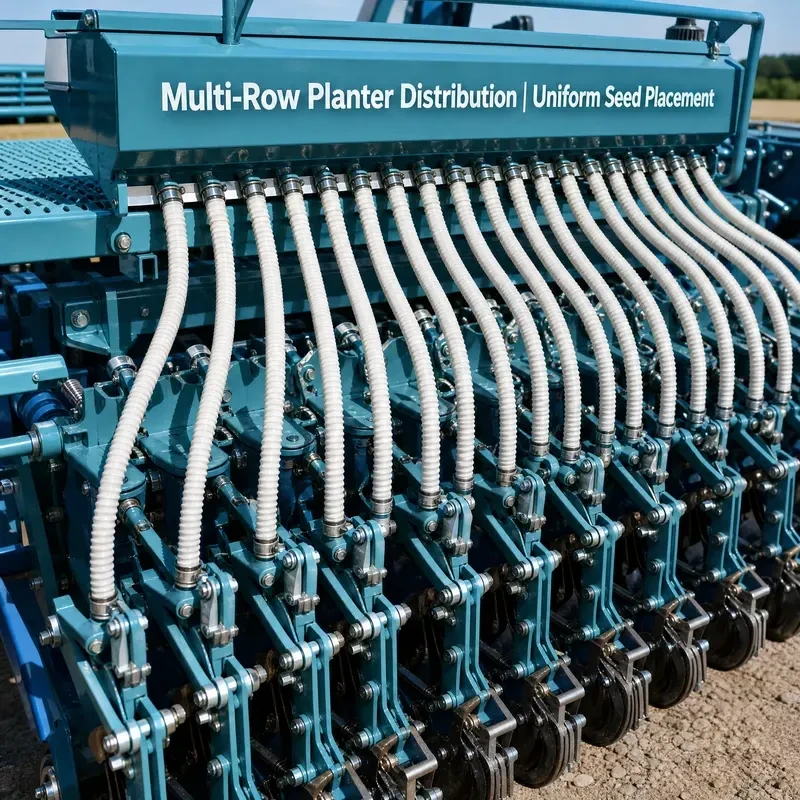
Guide to the ECOOSI PU seeder hose: ester-based polyurethane wall, embedded rigid PVC helix, smooth bore, -40 to +90 °C with peaks to +125 °C, 25-150 mm bore, 20 m and 30 m coils for air-suction seeders, grain drills and fertiliser lines.
The ECOOSI seeder hose is a polyurethane delivery duct with an embedded rigid PVC helix, built for air-suction seeders and precision planters. A smooth PU bore carries seed and granular fertiliser without the internal ridges that catch grain, the embedded helix holds the hose open under vacuum singulation and resists kinking when the toolbar folds, and the compound is UV stabilised for field use. The range is -40 °C to +90 °C with intermittent peaks to +125 °C, bore sizes run from 25 mm to 150 mm, and standard supply is 20 m or 30 m coils.
This guide covers what a seeder hose has to do, how the construction supports it, the field conditions that shorten hose life, and the selection rules that matter.
What a Seeder Hose Has to Do
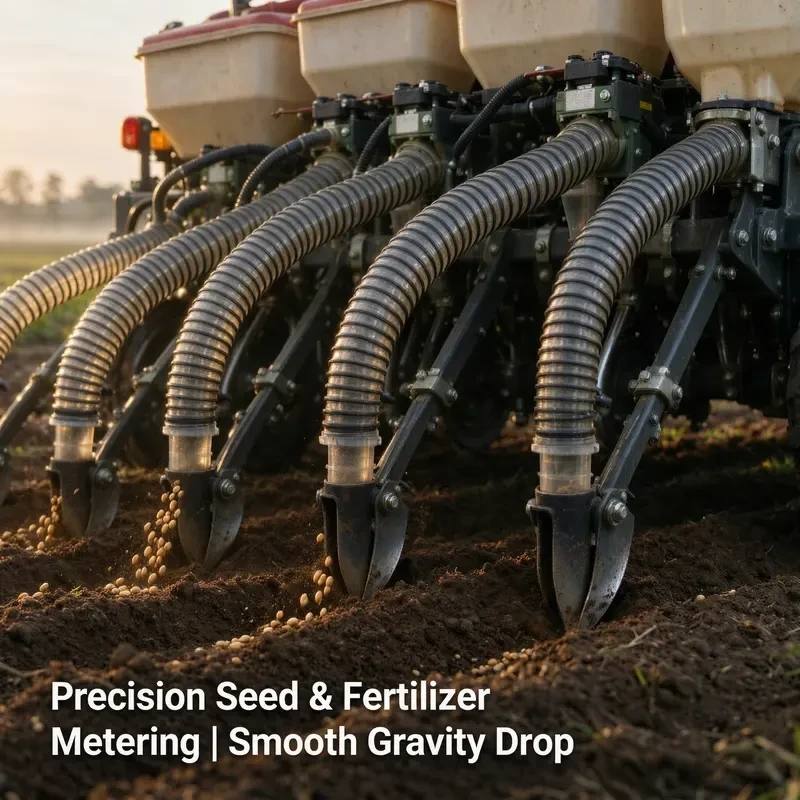
In a pneumatic planter, the hose is the last piece of the seed path. A metering unit singulates seed using vacuum or positive pressure, and the hose carries each seed from the meter to the row unit opener. Three requirements follow:
- The bore must stay clear. Any internal ridge, join or rough patch catches seed and fertiliser residue, and a partly blocked line changes the drop timing.
- The wall must stay round under vacuum. A collapsed hose starves the meter and the row skips.
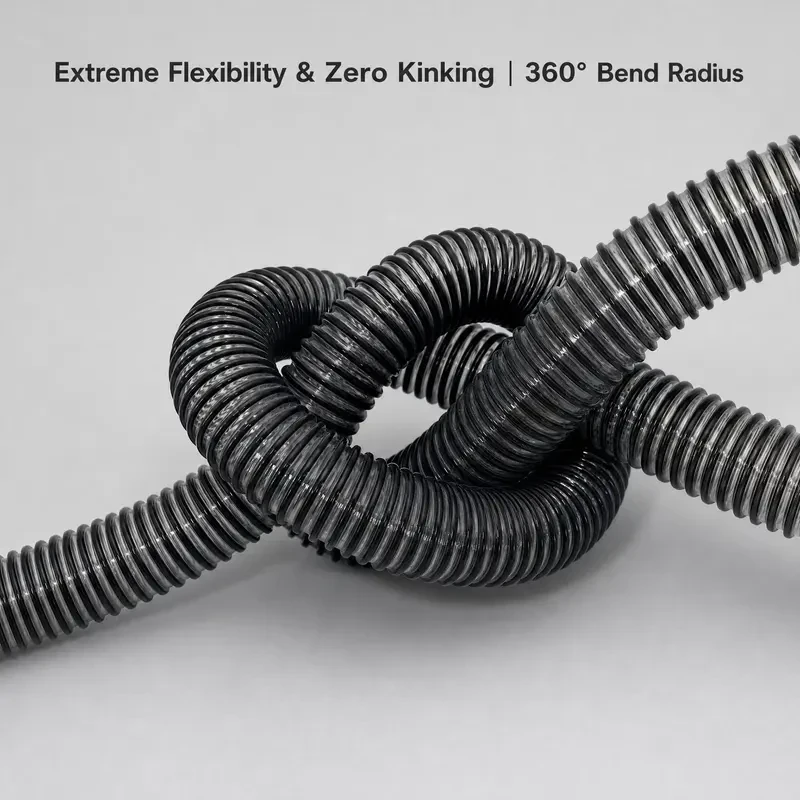
- The hose must bend without kinking as the planter folds at headlands and follows uneven ground.
Beyond that, the hose has to survive sun, fertiliser dust and early-spring cold for several seasons.
Construction
| Element | Material | Function |
|---|---|---|
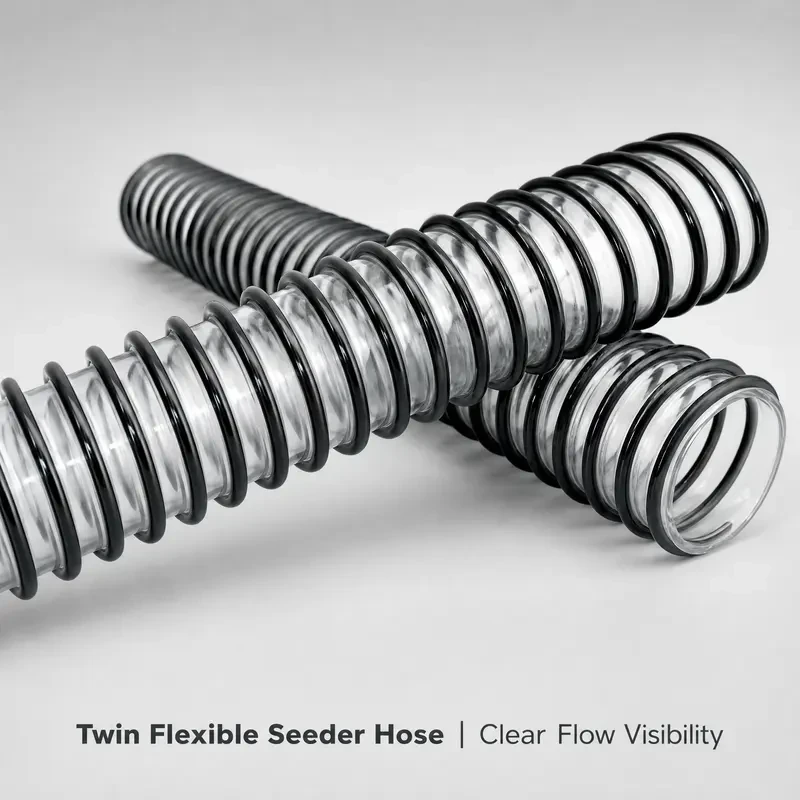
| Helix | Embedded rigid PVC spiral | Crush resistance under vacuum, kink resistance at the fold |
| Wall | Ester-based polyurethane, halogen-free and plasticizer-free | Abrasion resistance against seed and fertiliser, UV stabilised |
| Bore | Smooth interior | Low air drag, no ridge to catch grain |
| Outside | Corrugated spiral rib | Flexibility and a reliable surface for clamps |
The helix is embedded in the wall rather than laid loose inside the bore. That matters twice: there is no wire for seed to ride over, and the wall stays smooth while the rib outside provides the structure.
Smooth Bore and Seed Integrity
Seed damage in a planter usually comes from impact, not from the hose material. A rough bore or a step at a coupling makes seed bounce and crack; a smooth wall lets it travel with the airflow and arrive at the opener intact.
PU also absorbs impact better than a hard wall. Treated seed with a fragile coating, and brittle seed such as canola, benefit from a bore that gives slightly rather than one that chips and produces sharp edges.
Flexibility Across the Toolbar
On a wide planter the outer sections fold for transport and flex independently in the field. The hose has to follow without kinking, and it has to keep its bore while doing so. The embedded helix allows a tight bend radius of roughly one to one and a quarter times the bore, which is what makes a clean routing from a central seed cart to individual row units possible.
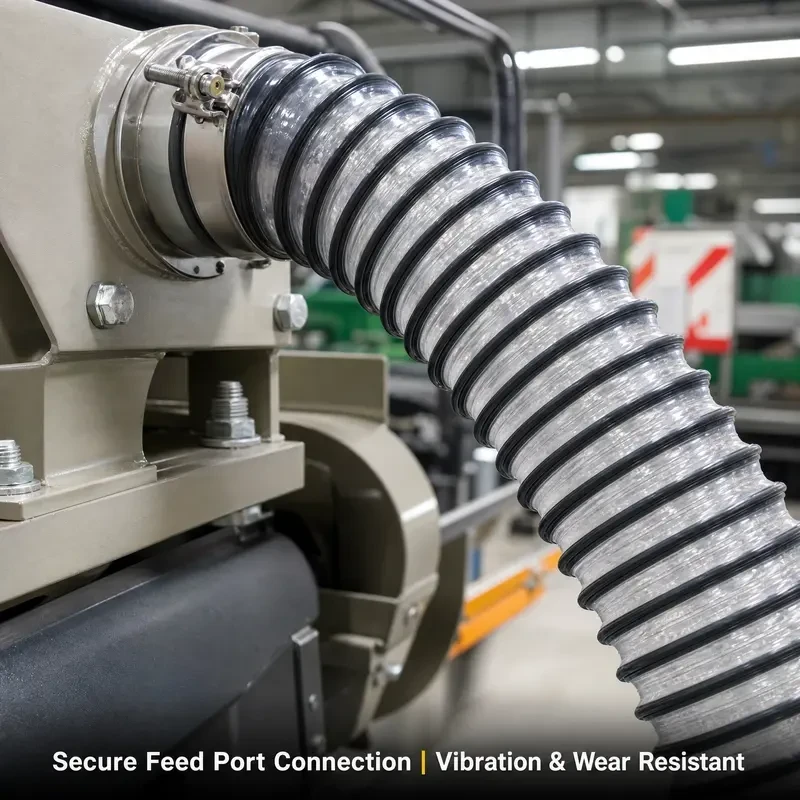
At the machine end, the hose clamps onto the feed port and takes continuous vibration. In the picture below, a clear hose with a black helix is clamped to a feed housing with a screw clamp, which is the usual arrangement on air seeders and fertiliser distribution heads.
Field Conditions That Shorten Hose Life
- UV and ozone — hoses left on the machine through summer embrittle from the outside. The PU compound is UV stabilised, but stored spare coils should still be kept out of direct sun.
- Fertiliser and chemical dust — granular fertiliser is abrasive and mildly aggressive. A smooth bore and a chemical-resistant wall reduce build-up and surface attack.
- Cold — the hose stays flexible down to -40 °C, which covers early-spring planting where a rigid PVC hose stiffens and cracks.
- Toolbar pinch — a hose routed across a fold point gets pinched every time the planter closes. Route clear of hinges and use the shortest practical run.
Colour and Configuration Options
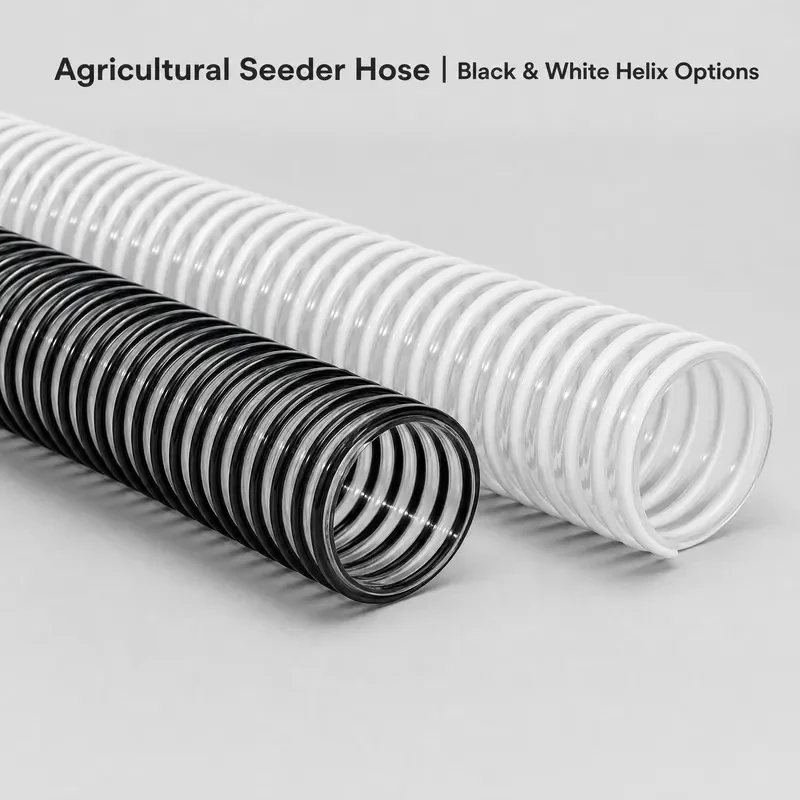
Black and white helix options are both available, which matters on a multi-row planter where colour coding helps identify seed versus fertiliser lines and simplifies fault finding in the field. Clear and translucent walls allow a visual check of flow without opening the line.
Applications
Air-suction and precision planters
Seed delivery and vacuum lines for corn, soybean, wheat, cotton, canola and sugar beet planters, from the central meter to the row unit.
Fertiliser broadcasting and air seeders
Granular fertiliser distribution, seed cart loading and unloading, and boom supply lines on air seeders.
Grain handling on the farm
Grain auger discharge, seed cleaning equipment, combine harvester transfer and chaff or straw suction.
Industrial dust and light material
Paper fibre, textile dust, wood shavings and plastic granules, where an abrasion-resistant flexible duct is needed at small to medium bore.
Cable and hose protection sleeve
On mobile agricultural equipment the same hose is used as a wear sleeve for hydraulic lines and sensor cables running along moving arms.
Technical Specifications
| Parameter | Specification |
|---|---|
| Wall material | Polyurethane, halogen-free and plasticizer-free, UV stabilised |
| Reinforcement | Embedded rigid PVC helix |
| Inner surface | Smooth bore |
| Outer surface | Corrugated spiral rib |
| Temperature | -40 °C to +90 °C, intermittent peak +125 °C |
| Bore sizes | 25 mm to 150 mm standard, OEM seeder sizes available |
| Bend radius | About 1.0 to 1.25 times the bore |
| Standard lengths | 20 m and 30 m coils, continuous uncut |
| Media | Grain, treated seed, granular fertiliser, dust, light chemical vapour |
Selection and Installation
- Match the bore to the meter, not the hose. Undersized hose restricts airflow and changes singulation; oversized hose slows the seed and increases bounce.
- Keep runs short and direct from the distribution head to the row unit, with the bend radius respected at every turn.
- Route clear of fold hinges and check the routing with the planter folded, not just open.
- Use the right clamp and check it after the first field pass; vibration loosens a poorly seated clamp.
- Clean the bore at the end of the season so fertiliser residue does not set inside the hose over winter.
- Store coils indoors, out of direct sun, to protect the UV-stabilised compound between seasons.
Frequently Asked Questions
What is the hose made of?
An ester-based polyurethane wall with an embedded rigid PVC helix. The bore is smooth and the outside is corrugated.
What temperature range does it cover?
-40 °C to +90 °C continuous, with intermittent peaks up to +125 °C.
Will it kink when the planter folds?
No, within the rated bend radius of about 1.0 to 1.25 times the bore. Route the hose clear of hinge points to avoid pinching.
Does it collapse under vacuum singulation?
The embedded helix holds the bore open under the vacuum levels used on air-suction planters.
What bore sizes and lengths are available?
25 mm to 150 mm as standard, supplied in 20 m or 30 m continuous coils, with custom coils and OEM seeder sizes on request.
Can one hose handle both seed and fertiliser?
Yes. The smooth bore and abrasion-resistant wall suit treated seed and granular fertiliser. Colour options help separate the two lines.
Why does the wall come in clear and coloured versions?
Clear or translucent walls allow a visual flow check; black and white helix colour coding helps identify lines on a multi-row planter.
Is it suitable for grain handling equipment?
Yes. Auger discharge, seed cleaning and combine transfer are common uses, as well as dust and light material extraction.
Choosing the Right Hose
For seed and fertiliser delivery this hose is the starting point. The PU ducting range lists the bores and wall options, the anti-static PU material handling hose guide covers bulk grain and pellet conveying with a grounding wire, and the municipal sweeper hose guide covers heavy suction duty. For a bore recommendation, a sample or an OEM quotation, contact the ECOOSI technical team.
Related Articles
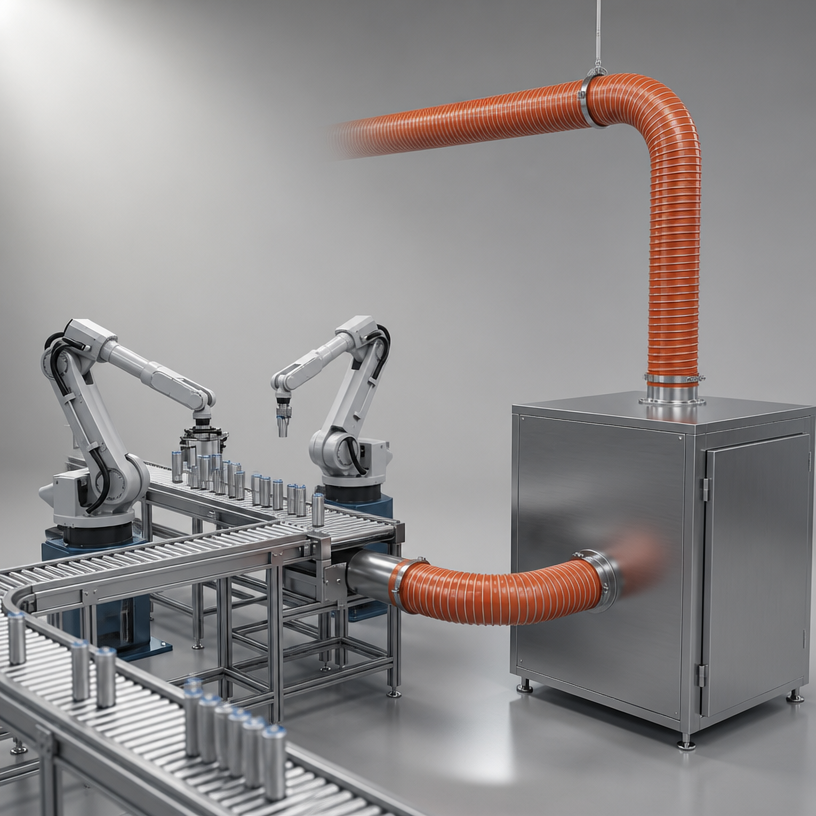
ECOOSI High-Temperature Silicone Hoses for Lithium Battery Factories: Withstanding Heat and Corrosion
Discover how ECOOSI high-temperature silicone duct hoses solve the dual challenges of extreme heat and chemical corrosion in lithium battery manufacturing. Learn about key features, applications, and cost benefits.

How to Select the Right Flexible Duct for HVAC Systems
A comprehensive guide to choosing the right flexible ductwork for HVAC systems, covering material selection, sizing, insulation, wire reinforcement, certifications, and installation best practices.
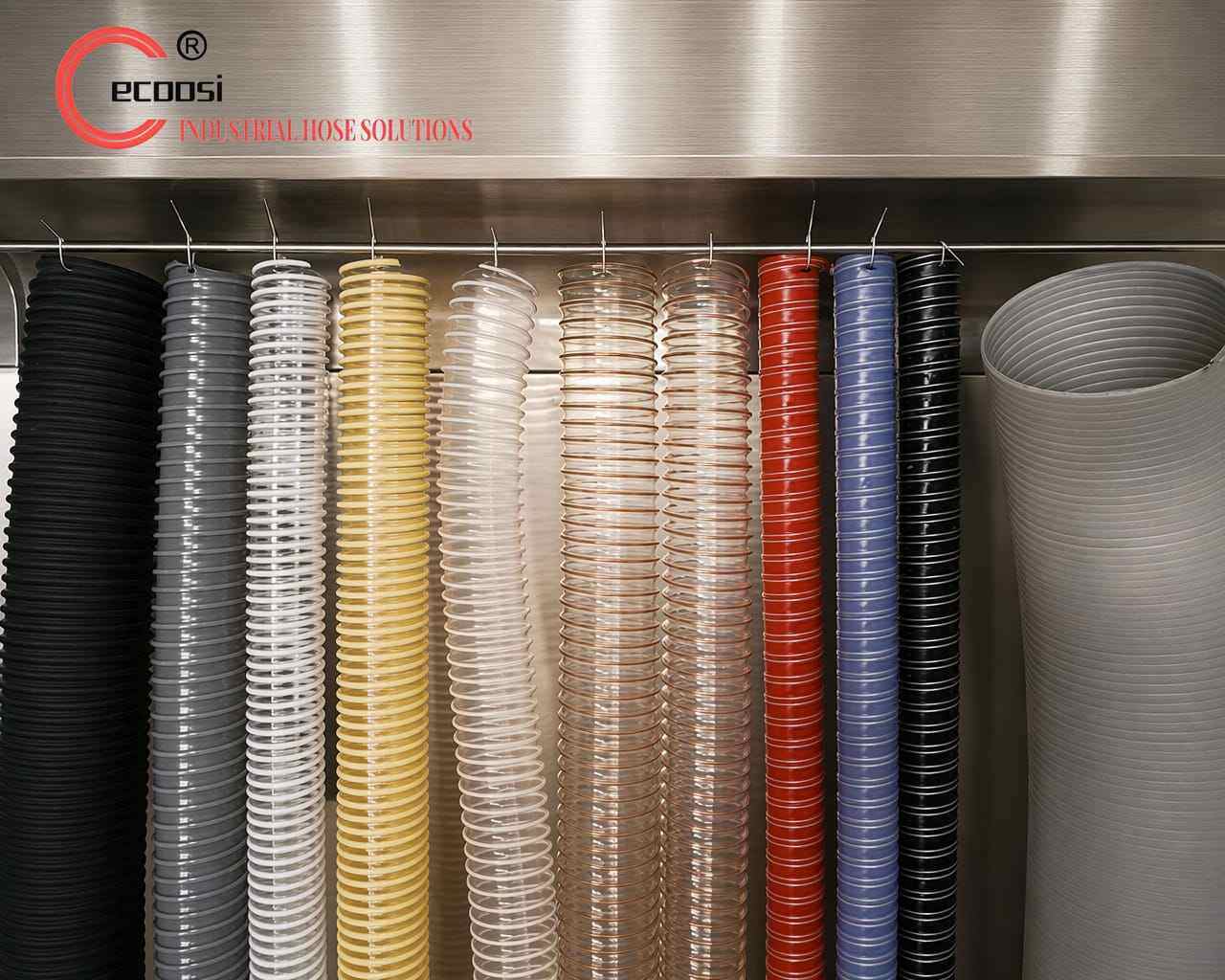
PVC vs PU vs Silicone Ducting: How to Choose the Right Flexible Hose for Your Application
Comprehensive comparison of PVC, PU, and Silicone flexible ducting materials. Learn key differences in temperature resistance, chemical compatibility, applications, and cost to select the optimal hose for your HVAC or industrial ventilation system.