
PVC Braided Suction and Discharge Hose: Fibre-Reinforced Helix Guide for Pumps and Dewatering
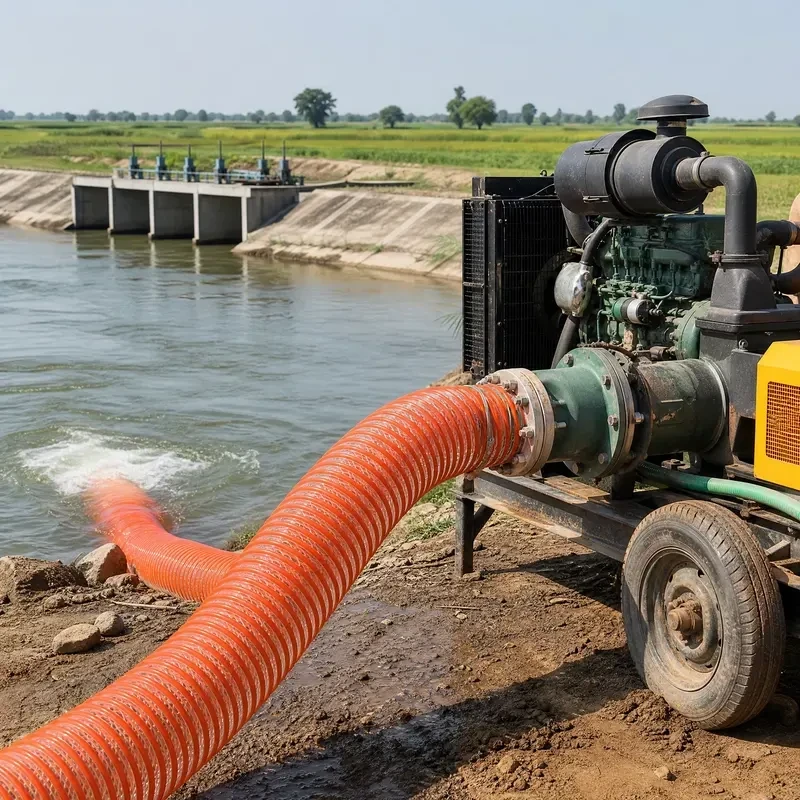
Guide to the ECOOSI PVC braided suction and discharge hose: double-ply virgin PVC wall, polyester braid for pressure, rigid orange PVC helix for vacuum, -20 to +65 °C, 25-150 mm bore, 20 m coils for trash pumps, dewatering, tankers and aquaculture.
The ECOOSI PVC braided suction and discharge hose is a dual-purpose clear PVC hose with a polyester braid for pressure and a rigid orange PVC helix for vacuum. A double-ply virgin PVC wall carries the braid and the helix, the bore is mirror-smooth for sediment-free flow, and the transparent wall lets operators watch the liquid. The working range is -20 °C to +65 °C, bore sizes run from 25 mm to 150 mm, and standard supply is 20 m coils or pre-coupled assemblies.
This guide explains why suction and discharge usually need different hoses, how the braid and the helix work together, what the specifications mean in the field, and where the hose is used.
One Hose for Suction and Discharge
Pump plumbing normally needs two different hoses. A suction line has to resist collapse under vacuum, so it carries a heavy rigid helix. A discharge line has to hold pressure without ballooning, so it carries a textile braid. Buyers end up stocking both, and crews end up using the wrong one.
This hose puts both reinforcements into the same wall:
- Under vacuum (trash pump intake, tanker suction, vacuum excavation) the rigid PVC helix holds the bore open.
- Under pressure (pump delivery, jetting, transfer) the polyester braid takes the hoop stress that would otherwise swell and burst a plain PVC hose.
Construction in Detail
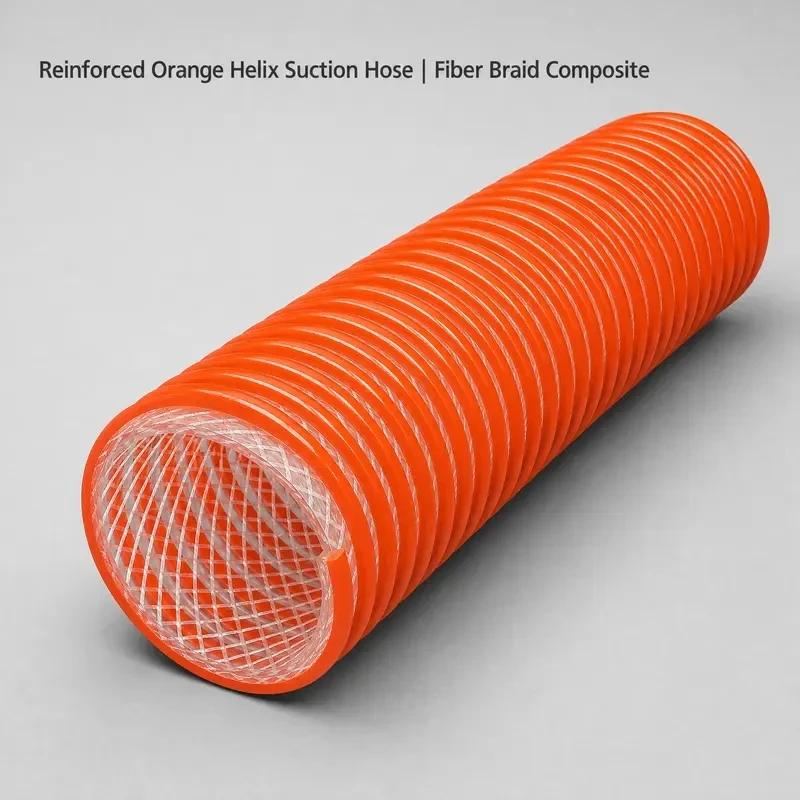
| Layer | Material | Function |
|---|---|---|
| Outer helix | Rigid orange PVC spiral | Anti-crush skeleton, wear strip against ground drag and impact |
| Pressure reinforcement | High-tensile polyester braided yarn | Burst and pressure hold |
| Body | Double-ply virgin PVC | Flexibility, chemical and weather resistance, clear wall |
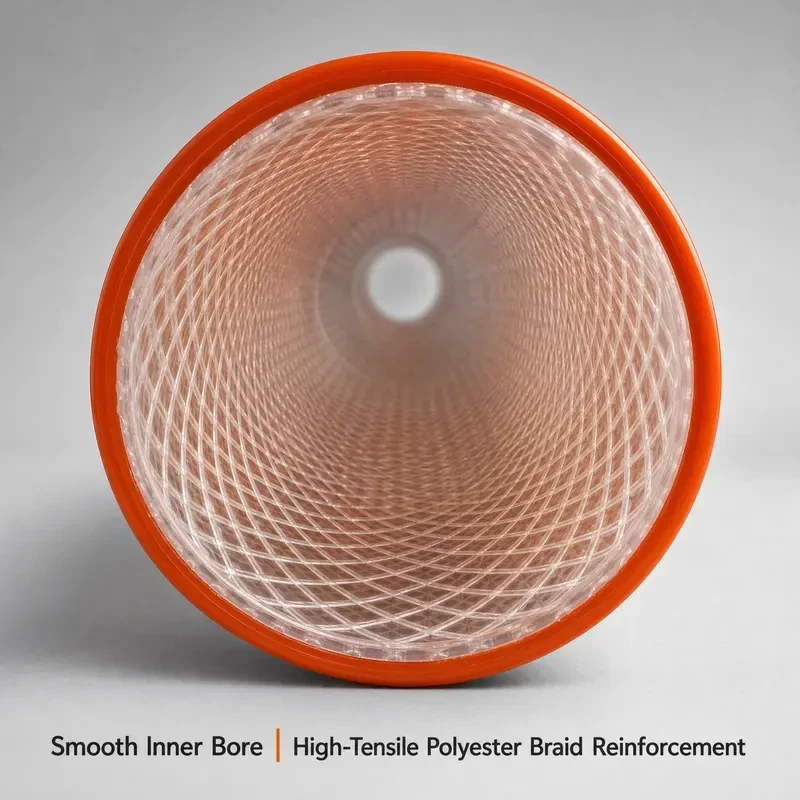
| Bore | Mirror-smooth PVC | Low friction, reduced sediment build-up |
The braid is a woven mesh rather than a set of loose longitudinal threads. A mesh grips in both directions, which is why it resists pressure surges and also keeps the wall from stretching when a hose is pulled full of water. The helix sits outside the PVC body, so when the hose is dragged across gravel or a concrete apron it is the orange rib that wears, not the pressure-bearing wall.
Visual Flow Monitoring
Because the wall is clear, the braid and the liquid are both visible. In a dewatering job that is worth more than it sounds: an operator can see whether the pump has lost prime, whether the intake is drawing air, and whether grit or sludge is building up at a low point — before the pump runs dry or the line blocks.
Pressure, Vacuum and Temperature
The two reinforcements solve different problems, and the limits are set by the weaker one in each direction. In practice:
- Vacuum duty is limited by the helix. Keep the bend radius generous; a sharp kink partly closes the bore and loads the helix.
- Pressure duty is limited by the braid and the coupling. Rated working pressure falls as bore increases, and end fittings are usually the first point of failure if they are not matched to the hose.
- Temperature is -20 °C to +65 °C. PVC stiffens below freezing and softens above the upper limit, so hot wash water or steam is out of range.
The compound is UV stabilised for outdoor use and resists mild acids and alkalis, which covers most construction, agricultural and municipal water duties.
Applications
Construction, rental and municipal dewatering
Trash pump suction and discharge, foundation pit and utility excavation dewatering, bypass pumping and flood relief. Below, a diesel trash pump on a river bank is running a long orange suction and delivery line over rough ground.
Engineering and service vehicles
Vacuum tanker suction, hydro-excavation units, street washing vehicles and sewer jetting support lines, where the hose has to take vacuum on the intake side and pressure on the delivery side of the same vehicle.
Aquaculture and commercial fisheries
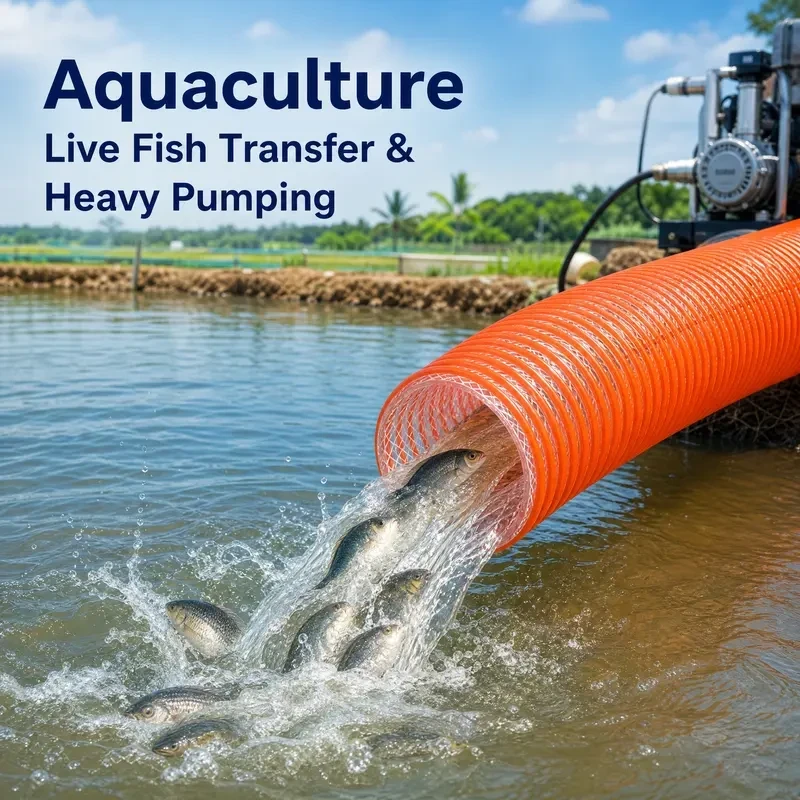
Live fish transfer, pond and tank pumping, aeration lines and marine water handling. The smooth bore and clear wall suit fish transfer, where a rough interior or an unseen obstruction causes injury and loss.
Agriculture and irrigation
High-volume irrigation from rivers and reservoirs, liquid fertiliser transfer and farm manifold lines. The hose is light enough to move between fields and stiff enough not to collapse on the suction side of a tractor-driven pump.
Industrial liquid and dry bulk transfer
Plastic pellets, wood shavings, dry powders, grain and non-corrosive chemical solutions, plus septic and sludge suction where the bore has to stay clear.
Technical Specifications
| Parameter | Specification |
|---|---|
| Construction | Double-ply virgin PVC, smooth bore |
| Pressure reinforcement | High-tensile polyester braided mesh |
| Vacuum reinforcement | Rigid orange PVC spiral helix |
| Working temperature | -20 °C to +65 °C |
| Bore sizes | 25 mm to 150 mm standard, metric and imperial |
| Standard length | 20 m coil, custom coils and pre-coupled assemblies |
| Appearance | Clear tube with orange, white or custom helix |
| Flow | Mirror-smooth inner surface |
| Media | Water, wastewater, slurry, mud, grain, granules, mild acids and alkalis |
Manufacture and OEM Supply
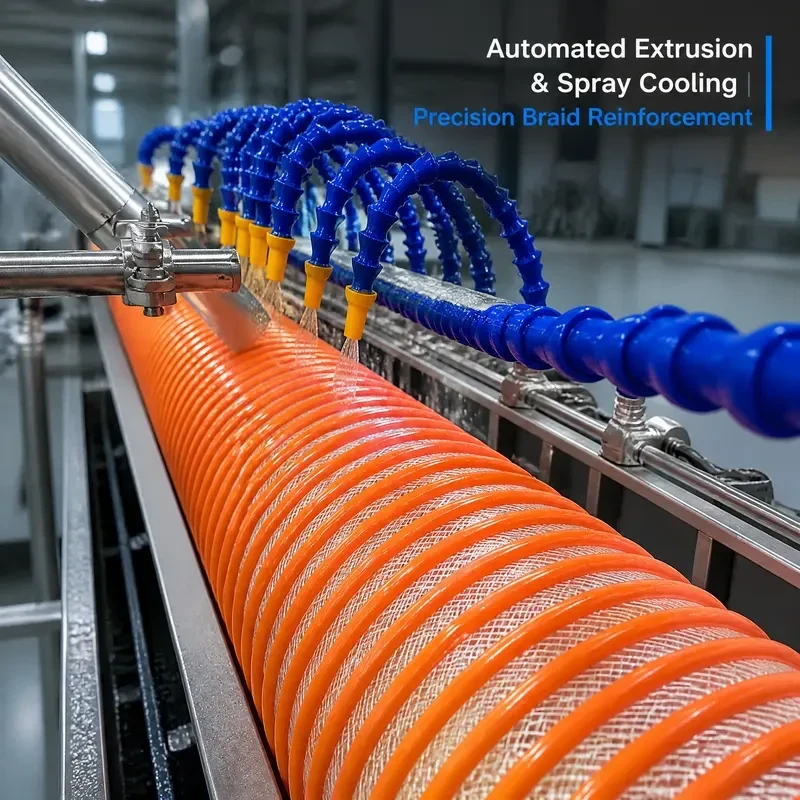
The hose is produced by continuous extrusion with the braid laid in and the helix formed over the body, followed by spray cooling. Forming the whole wall in one pass keeps the braid encapsulated rather than laid loose between two bonded layers, which is where cheaper hose separates after a season of pressure cycling.
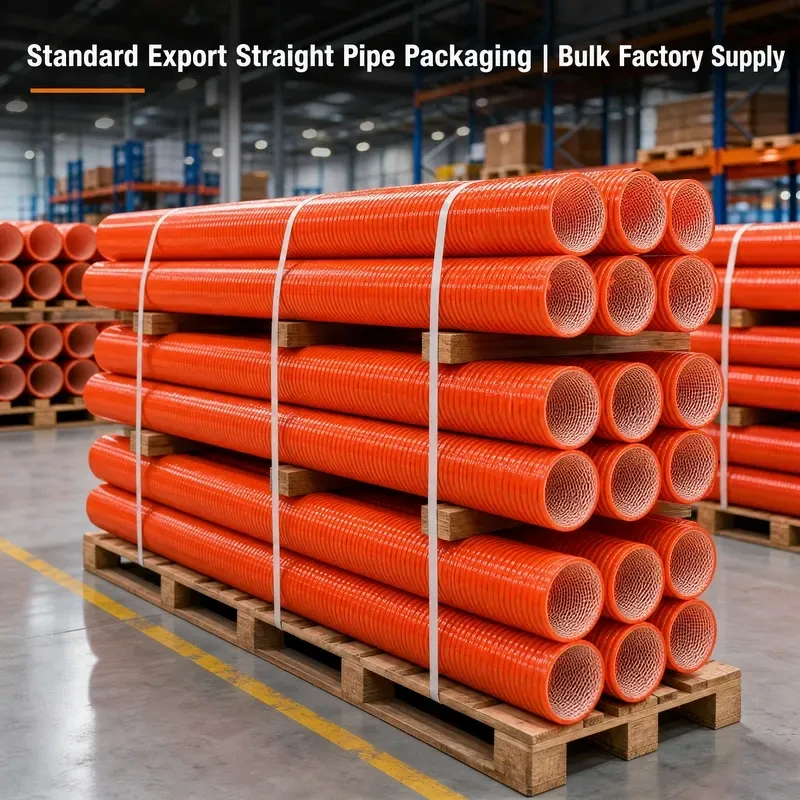
Coils and straight lengths are supplied strapped on pallets for export, and OEM orders can be made in custom diameters, colours, lengths and print. Pre-coupled assemblies with camlock, flange or threaded fittings can be supplied for fleet replacement programmes.
Installation and Care
- Match the coupling to the hose, not just the pump. A fitting that is too small restricts flow, and a loose one leaks air into the suction side.
- Support the suction line. A full hose is heavy; a hanger near the pump stops the wall carrying the weight.
- Keep bends wide on the suction side. A kink partly closes the bore and can starve the pump.
- Drain after use and store coiled, out of direct sun, so the PVC does not take a permanent set.
- Do not exceed the temperature range. Hot wash water above +65 °C softens PVC and shortens life.
- Check the helix at the ends. Couplings and dragging damage the rib first; trim and re-couple before the wall is exposed.
Frequently Asked Questions
Can one hose be used for both suction and discharge?
Yes. The polyester braid handles pressure and the rigid PVC helix handles vacuum, so a single hose covers both sides of a trash pump or tanker.
What temperature range does it cover?
-20 °C to +65 °C. It is not intended for steam, hot wash water or high-temperature process fluids.
What bore sizes are available?
25 mm to 150 mm as standard, in metric and imperial sizes, supplied in 20 m coils or cut to length.
Is the hose suitable for drinking water?
It is made from virgin PVC and is used for agricultural and general water transfer. For potable water schemes, confirm the applicable local approval before use.
Why is the wall transparent?
So operators can see the liquid, check for air in the suction line, and spot sediment build-up or a blockage.
Can it handle live fish transfer?
Yes. The smooth bore and clear wall make it a common choice for aquaculture transfer and pond pumping.
Does the orange helix protect the hose?
It acts as an external wear strip. When the hose is dragged over gravel or concrete, the rib takes the abrasion instead of the pressure-bearing wall.
Can you supply assembled hoses with fittings?
Yes. Pre-coupled assemblies with camlock, flange or threaded ends can be supplied, and custom lengths and colours are available for OEM orders.
Choosing the Right Hose
For pump intake and delivery duty this hose covers both sides of the job. The PVC ducting range covers air and fume versions of the same material family, the flexible ducting range covers general extraction, and the anti-static PU material handling hose guide covers dry bulk conveying. For a pressure rating at your bore size, a sample or a fleet quotation, contact the ECOOSI technical team.
Related Articles
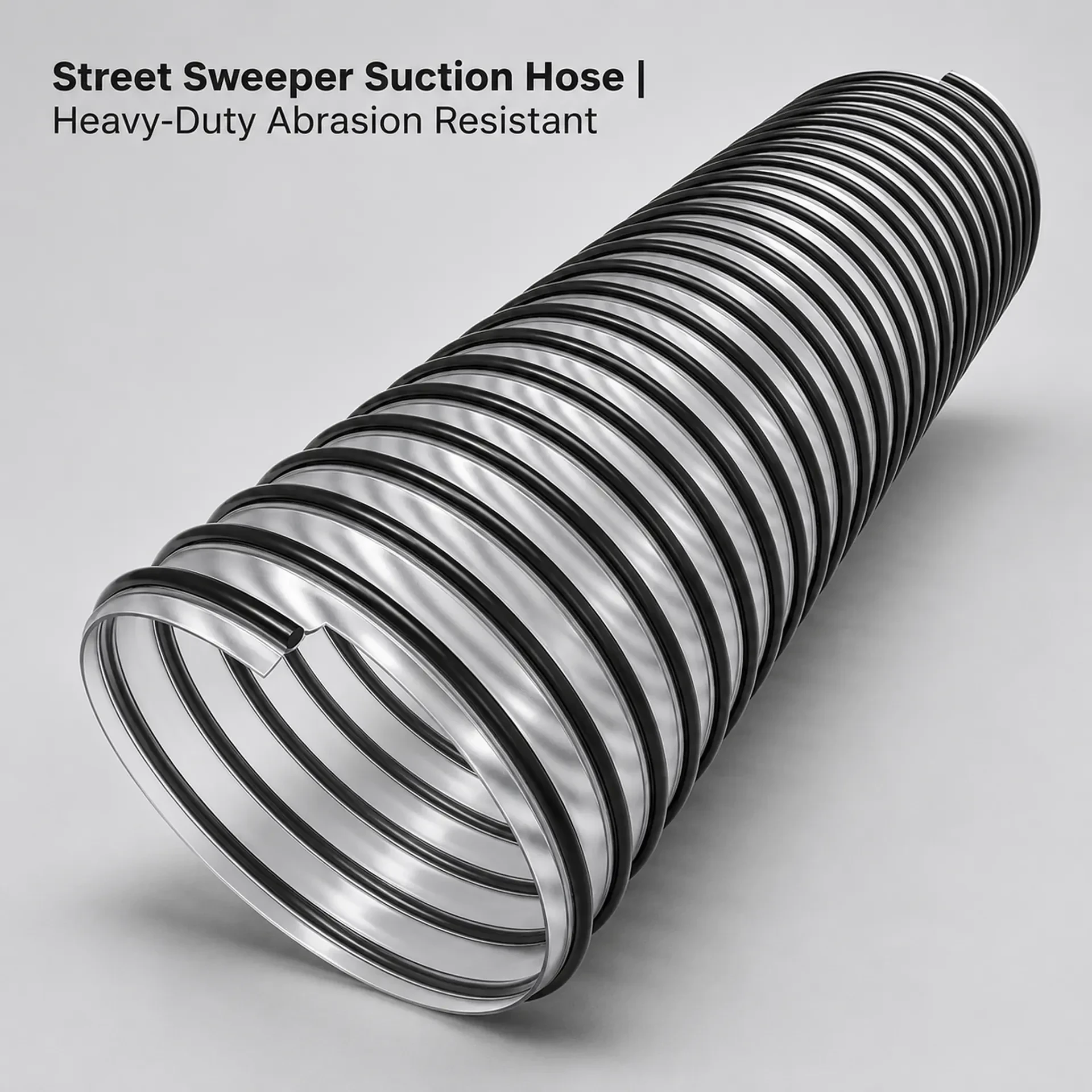
Municipal Street Sweeper PU Suction Hose: Wear-Strip and Copper-Plated Helix Guide
Guide to the ECOOSI heavy-duty polyurethane sweeper hose: 0.9 mm Pre-PUR wall, copper-plated spring steel helix, external black wear strip, -40 to +100 °C with peaks to +125 °C, 10 m coils for street sweepers, runway vacuum trucks and industrial vacuum systems.
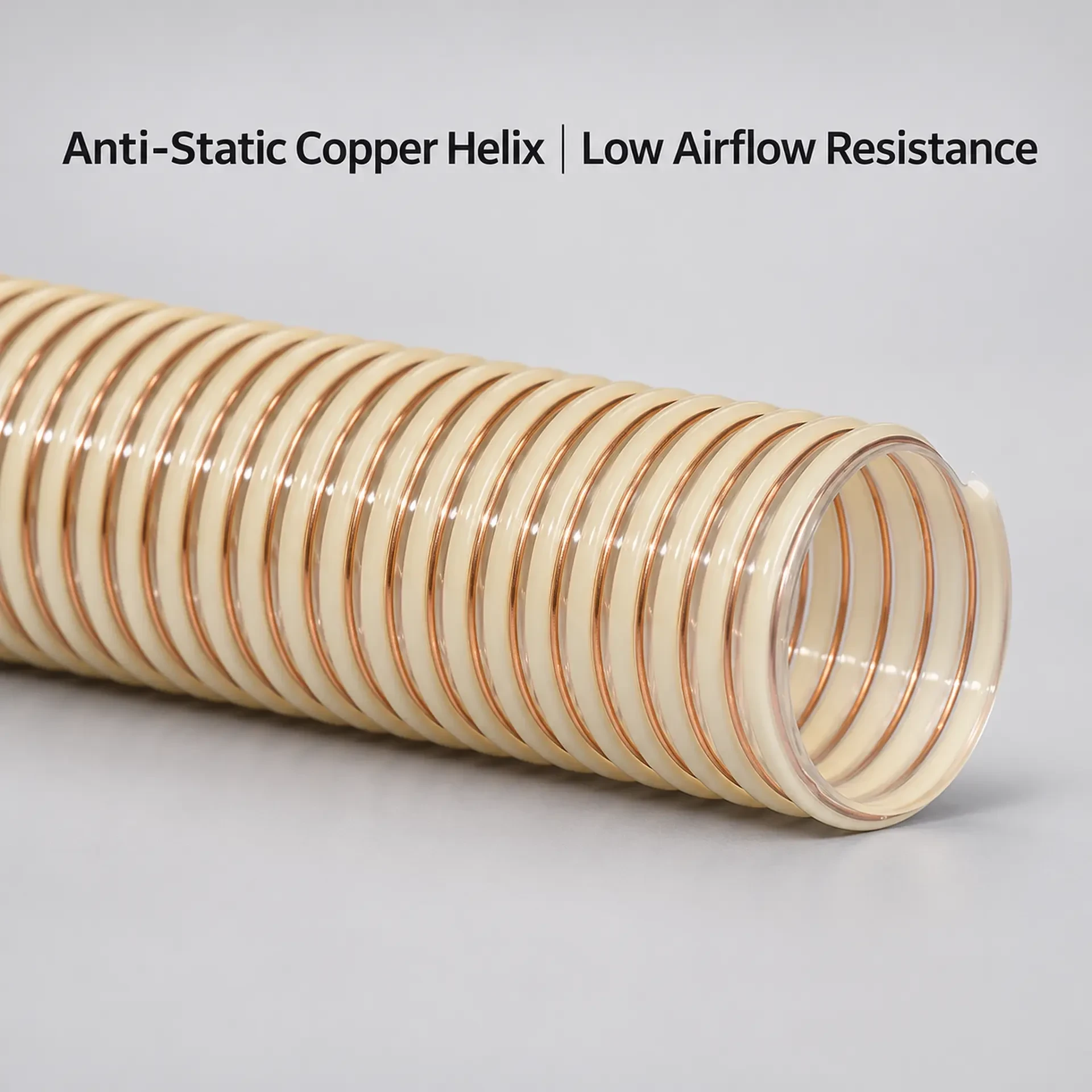
Anti-Static PU Material Handling Hose: Copper Wire Helix Guide for Grain, Sand and Plastic Pellets
Guide to the ECOOSI anti-static polyurethane material handling hose: rigid PVC helix, embedded copper grounding wire below 10^8 ohm, smooth bore, -40 to +90 °C with peaks to +125 °C, 25-300 mm bore for grain, sand, plastic pellets and wood chips.
800 °C High-Temperature Ducting Hose: 3-Layer High-Silica Fiberglass Guide for Furnace and Engine Test Exhaust
Guide to the ECOOSI 800 extreme high-temperature ducting hose: 3-layer coated fiberglass and high-silica composite, external galvanized clamp-profile helix, -60 to +800 °C, 50-1000 mm diameters, for furnace exhaust, engine test cells and hot dust extraction.