
Food-Grade Ether-Based PU Hose with Stainless Steel Helix: Powder Conveying Guide
Guide to the ECOOSI ether-based food-grade PU hose with stainless steel wire helix: hydrolysis and microbe resistant wall, hose wall, smooth bore, -40 to +100 °C with peaks to +125 °C, 10 m coils for food powder conveying, pharma charging and rail vacuum sewage.
The ECOOSI hygienic hose is an ether-based polyurethane suction duct reinforced with a stainless steel wire helix. The ether formulation resists hydrolysis and microbial growth in warm, humid service, the stainless helix holds the bore under vacuum without rusting, and the smooth transparent wall allows a visual check of the product. The range is -40 °C to +100 °C with intermittent peaks to +125 °C, supplied in 10 m lengths with light, medium and heavy wall options.
This guide covers why ether PU is used where ester PU fails, how the stainless helix and grounding work, the temperature and cleaning limits, and the duties the hose is specified for in food, pharmaceutical and rail applications.
What a Food and Pharma Hose Has to Do
A powder conveying hose in a food or pharma plant is judged on four things before pressure or flexibility:
It must not add anything to the product. No odour, no taste, no plasticiser migration and no shedding into the bore.
It must survive washdown and humidity. Warm water, sanitising chemicals and standing moisture are normal, not exceptional.
It must stay open under vacuum. A collapsed line stalls the loader and can damage the product.
It must be cleanable. A smooth bore and a wall that does not swell are what allow cleaning between batches.
The material choice addresses the first two; the helix and the bore geometry address the last two.
Construction
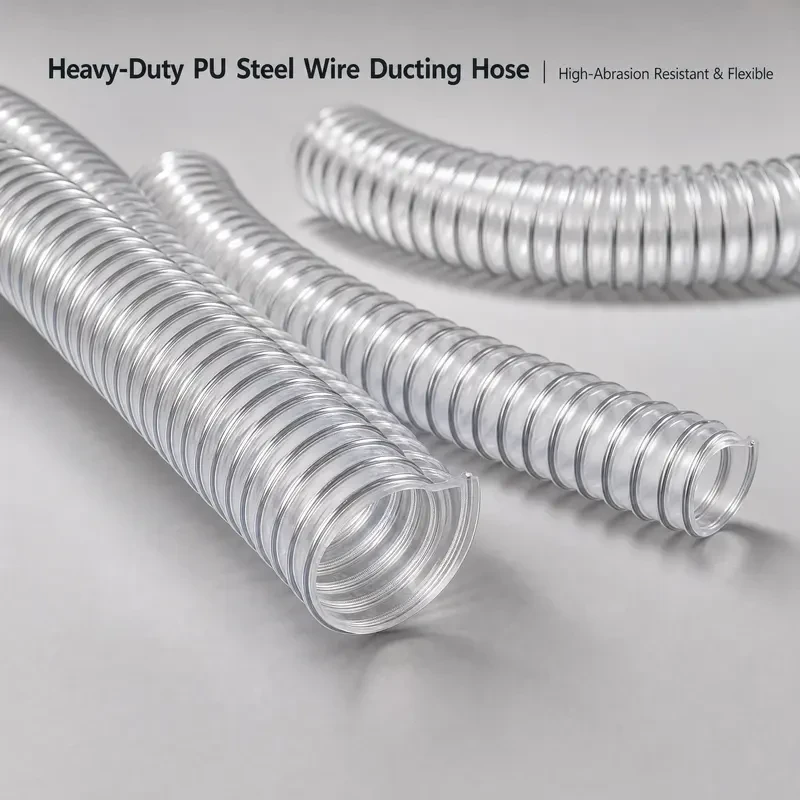
Transparent PU wall over a stainless steel helix: the wire is visible through the wall along the full length.
Element | Material | Function |
|---|---|---|
Helix | Stainless steel spring wire | Vacuum and crush resistance, no corrosion, groundable conductor |
Wall | Ether-based polyurethane, halogen-free and plasticizer-free | Hydrolysis and microbe resistance, abrasion resistance, odour-free |
Bore | Smooth interior | Low friction, reduced powder hang-up, easier cleaning |
Outside | Corrugated profile | Flexibility, tight bending radius |
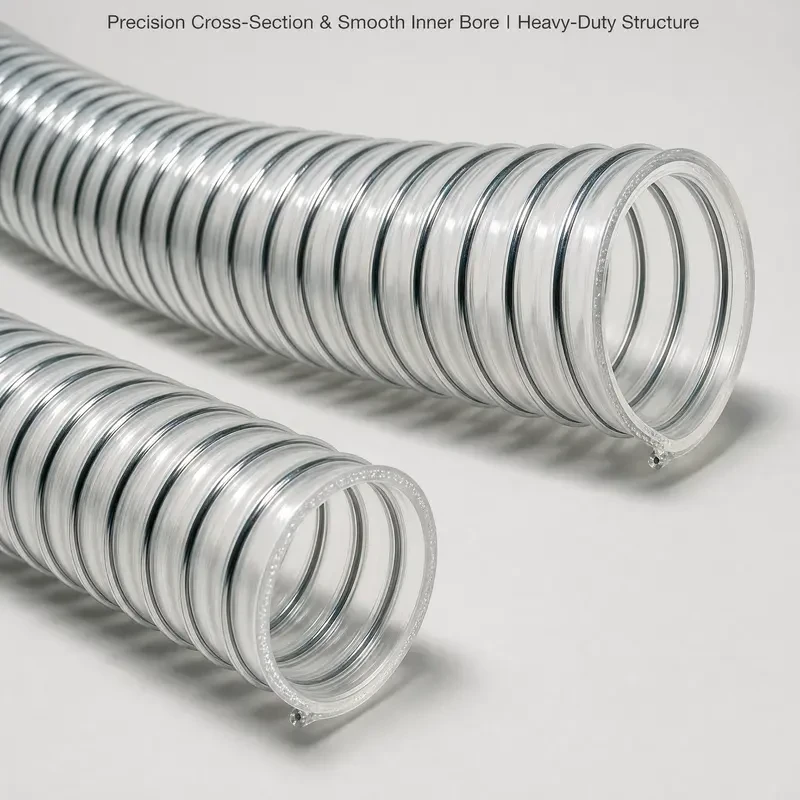
Cross-section: smooth bore, wire fully encapsulated, no exposed metal in the product path.
Why Ether-Based PU Instead of Ester-Based
Both are polyurethanes, and both are abrasion resistant. The difference shows up in wet and warm service. Ester-based PU hydrolyses: moisture attacks the polymer chain, the wall turns soft and cloudy, and eventually it cracks from the inside. In a dairy plant washed down nightly, or a pharma line cleaned in place, that is the normal condition rather than an exception.
Ether-based PU is far less susceptible to hydrolysis, which is why it is the usual specification for food, beverage and pharmaceutical duty. It also resists microbial growth on the wall better than ester grades, and it is formulated without plasticisers or halogens, so there is no softener to migrate into the product.
The compound is described as food-contact grade. For regulated lines, confirm the applicable material declaration and local food-contact requirement with us before commissioning, since approvals differ by market.
Stainless Helix, Vacuum and Static
The stainless wire is embedded in the wall rather than loose inside the bore, so no metal is exposed to the product. It serves three purposes:
Vacuum stability. The helix keeps the bore circular under loader suction, so throughput does not fall away as the line loads up.
No corrosion. In washdown conditions a galvanised wire would rust from the cut ends inward; stainless does not.
Grounding path. The wall is dissipative, and bonding the helix to earth at both ends gives static generated by fast-moving powder a controlled path away from the surface.
Grounding still has to be done deliberately. Bond the helix at both ends and check continuity with a meter. For combustible dust duty, the earthing scheme belongs in the site risk assessment rather than on the hose datasheet.
Smooth Bore, Cleaning and Cross-Contamination
Powder hang-up is a cleaning problem as much as a flow problem. Material that sits in a corrugation or a rough patch is difficult to remove and can carry over between batches. A smooth bore reduces the places where powder can lodge, and a transparent wall lets an operator see whether the line is clear after cleaning.
The hose is intended for washdown and clean-in-place support rather than as a permanently installed CIP pipeline; confirm the cleaning agents and temperatures with us if the line is sanitised in place.
Temperature Range
The working range is -40 °C to +100 °C with intermittent peaks to +125 °C. That covers warm wash water, dried product and ambient plant conditions. It is not a hot-gas hose: for exhaust or steam above the peak limit, a high-temperature duct is the correct choice.
Applications
Food and dairy processing
Pneumatic conveying of milk powder, infant formula, sugar, flour, rice, cereals, coffee, tea, starch, spices and frozen products, plus vacuum loader lines and bulk bag charging. The picture below shows a central vacuum conveying installation with multiple coloured hoses feeding process equipment.
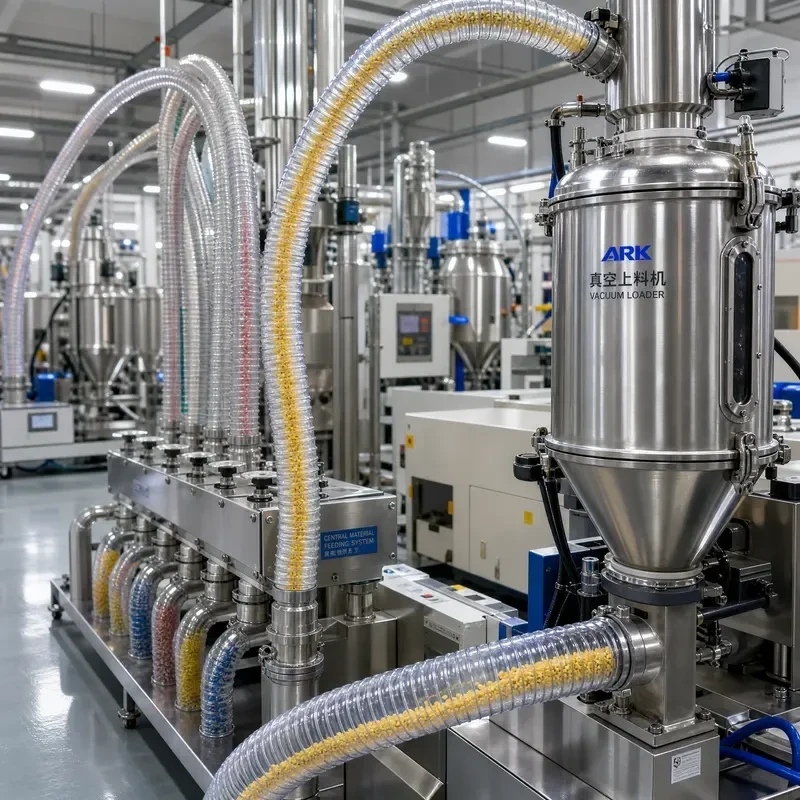
Central vacuum conveying: transparent hoses let operators see product flow at each drop point.
Pharmaceutical and nutraceutical
Tablet presses, capsule fillers, fluidised bed dryers, powder dosing lines and bulk bag discharge, where the wall has to stay clean and the bore has to stay clear.
Rail transit and aviation sanitation
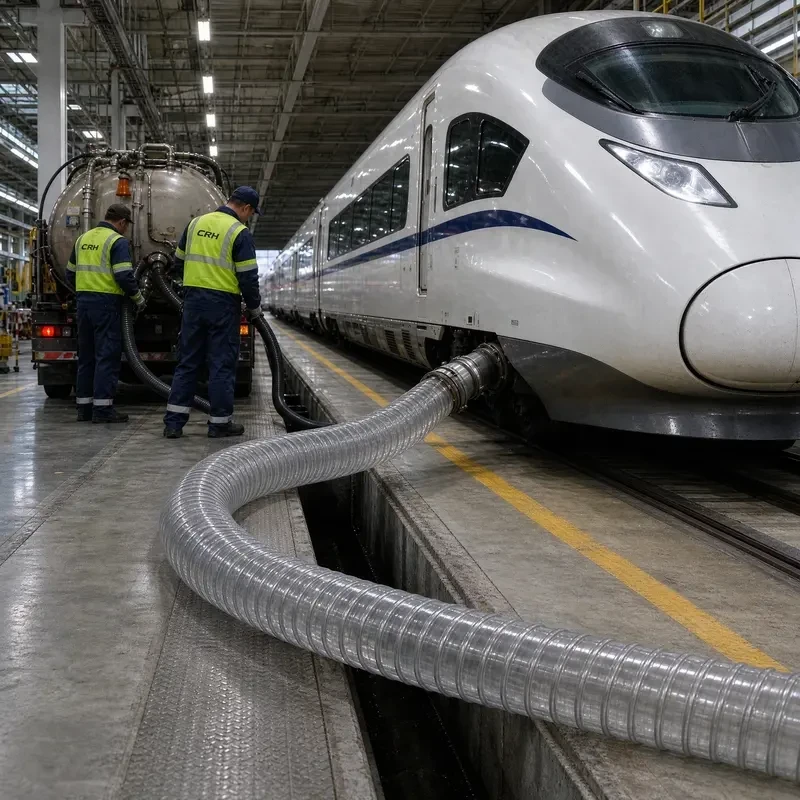
Vacuum toilet sewage suction on high-speed train depot pumping stations, passenger car servicing and aircraft waste evacuation. The photo below shows a CRH train set being serviced at a depot with a suction hose run from a tanker to the car.
Depot servicing: a long suction run from the tanker to the car, dragged across the platform.
Chemical and dust-hazard areas
Conveying of fine powders, plastic masterbatch, toner and chemical granulates where a dissipative, cleanable hose is needed. Combustible dust installations still require a site assessment.
Cleanroom and automated feed lines
Cleanroom material transfer, automated animal feed systems and pharmaceutical-grade industrial vacuums.
Technical Specifications
Parameter | Specification |
|---|---|
Wall material | Ether-based polyurethane, food-contact grade, halogen-free, plasticizer-free |
Reinforcement | Stainless steel spring wire helix, embedded |
Bore | Smooth, transparent wall |
Static behaviour | Dissipative wall, groundable through the helix |
Temperature | -40 °C to +100 °C, intermittent peak +125 °C |
Standard length | 10 m per piece, custom coils available |
Wall options | Light, medium and heavy duty |
Colour | Crystal clear, custom colours and private branding |
Media | Dry powders, granules, oils, greases, cleaning agents, mild acids and alkalis |
Supply and Customisation
Hose is supplied in 10 m lengths, coiled and strapped so the wall is not crushed in transit. Diameters, wall thickness, colour, length and print can be specified for OEM and distributor programmes.
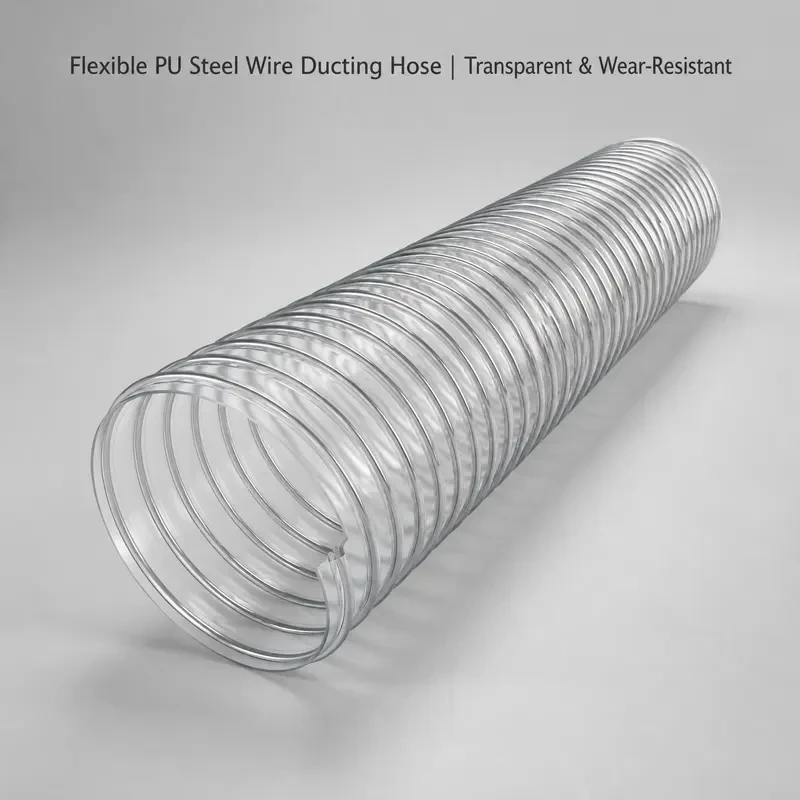
Coiled supply: transparent wall, embedded helix, ends ready for coupling.
Installation and Care
Confirm the material declaration against your food-contact or pharma requirement before commissioning.
Bond the helix at both ends and verify continuity after any hose change.
Support long horizontal runs so the wall is not carrying the weight of product.
Keep the bend radius generous at the loader inlet, where vacuum is highest.
Drain and dry after washdown and store coiled, away from direct sun.
Inspect the bore for scratches and discolouration at the ends, where couplings and clamps do the damage.
Frequently Asked Questions
What is the hose made of?
An ether-based polyurethane wall with an embedded stainless steel wire helix. The bore is smooth and the wall is transparent.
Why ether-based rather than ester-based PU?
Ether PU resists hydrolysis far better, so the wall does not soften or crack in warm, humid or washdown service, which is the normal condition in food and pharma plants.
Is it suitable for food contact?
The compound is described as food-contact grade, halogen-free and plasticizer-free. Confirm the applicable material declaration for your market before use on a regulated line.
What temperature range does it cover?
-40 °C to +100 °C continuous, with intermittent peaks to +125 °C.
Can the hose be grounded for static?
Yes. The wall is dissipative and the stainless helix provides a conductor; bond it at both ends and check continuity.
What length is supplied?
10 m pieces as standard, with custom coils and lengths on request.
Is it used for train toilet servicing?
Yes. High-speed rail depot vacuum sewage suction is a standard application, along with aircraft waste evacuation.
Can it be cleaned in place?
It is intended for washdown and cleaning support with a smooth, non-absorbing bore. Confirm the cleaning agents and temperatures with us if the line is sanitised in place.
Choosing the Right Hose
For clean powder and granule conveying this hose is the starting point. The PU ducting range lists bores and wall options, the anti-static PU material handling hose guide covers bulk grain and pellet lines with a copper wire, and the PU seeder hose guide covers agricultural seed delivery. For a material declaration, a sample or an OEM quotation, contact the ECOOSI technical team.
Related Articles
PVC Layflat Discharge Hose: 4, 6 and 10 Bar Irrigation and Dewatering Guide
Guide to the ECOOSI PVC layflat discharge hose: virgin PVC wall with braided polyester yarn, 4, 6 and 8-10 bar working pressure, -5 to +65 °C, 20-408 mm bore, 100 m rolls for irrigation, dewatering, mining and pump discharge.
PU Seeder Hose with Rigid PVC Helix: Air-Suction Planter Delivery Guide
Guide to the ECOOSI PU seeder hose: ester-based polyurethane wall, embedded rigid PVC helix, smooth bore, -40 to +90 °C with peaks to +125 °C, 25-150 mm bore, 20 m and 30 m coils for air-suction seeders, grain drills and fertiliser lines.
PVC Rubber Grit Hose: Yellow Helix Abrasion-Resistant Suction Guide for Blasting and Duct Cleaning
Guide to the ECOOSI heavy-duty PVC and rubber compound grit hose: soft elastomer wall, rigid yellow PVC helix, mirror-smooth bore, -10 to +60 °C standard or -20 to +80 °C heavy-duty, 51-203 mm bore, 20 m coils for blasting, duct cleaning and slurry recovery.