
PVC Layflat Discharge Hose: 4, 6 and 10 Bar Irrigation and Dewatering Guide
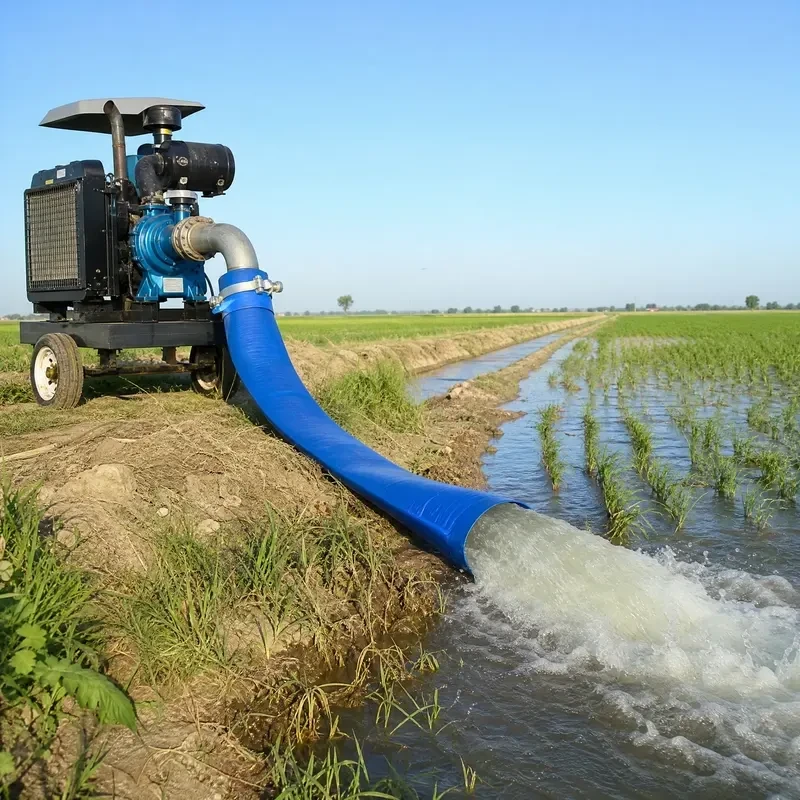
Guide to the ECOOSI PVC layflat discharge hose: virgin PVC wall with braided polyester yarn, 4, 6 and 8-10 bar working pressure, -5 to +65 °C, 20-408 mm bore, 100 m rolls for irrigation, dewatering, mining and pump discharge.
The ECOOSI layflat discharge hose is a PVC water hose reinforced with high-tensile braided polyester yarn, supplied flat on 100 m rolls. It is offered in three pressure classes — 4 bar light duty, 6 bar medium duty and 8 to 10 bar heavy duty — with bore sizes from 20 mm to 408 mm. The wall is virgin PVC with a UV-stabilised cover, the working range is -5 °C to +65 °C, and the hose rolls flat for storage and container shipping, then rounds out under pump pressure.
This guide explains why layflat is used instead of rigid pipe, how the yarn reinforcement sets the pressure class, what the temperature and media limits are, and how to choose between the three pressure tiers.
Why Use Layflat Instead of Rigid Pipe
A 100 m run of rigid pipe is heavy, needs joints and a vehicle, and is awkward to move between fields or excavation pits. A layflat hose is the opposite: it stores as a flat coil, deploys by hand, follows ground contours without extra fittings, and rewinds onto a reel or into a coil. For seasonal irrigation, temporary dewatering and pump discharge, that portability is usually worth more than the extra wall stiffness of pipe.
The trade-off is that the wall has to hold pressure while staying thin enough to roll flat, which is why the yarn reinforcement matters more here than in any other hose type.
Construction
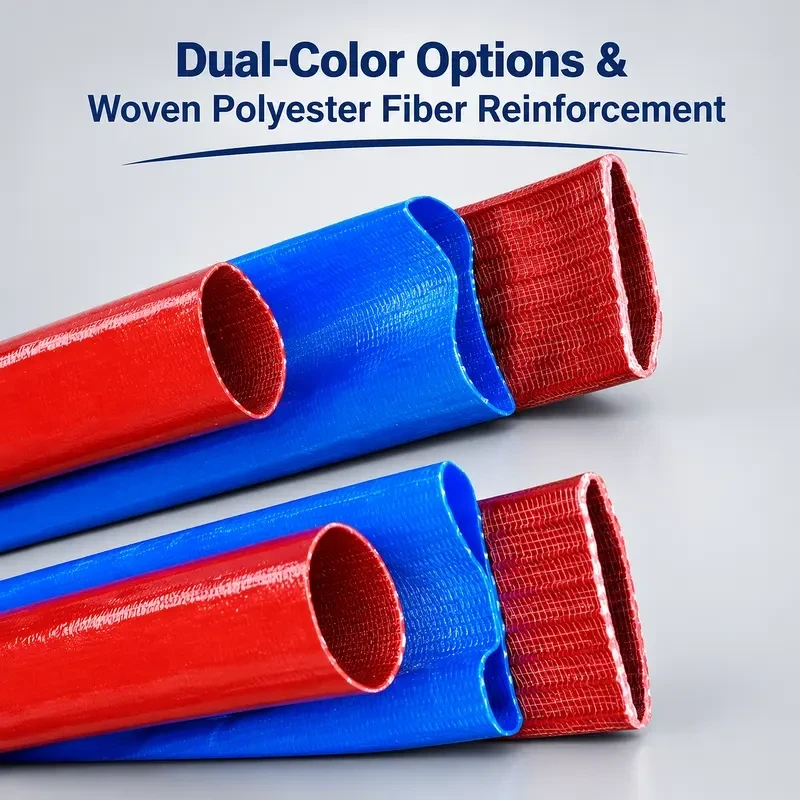
Cut-away view: PVC cover, dense woven polyester core, smooth inner tube — the three layers that make a layflat hose hold pressure.
Layer | Material | Function |
|---|---|---|
Outer cover | Virgin PVC compound, UV stabilised | Weather and abrasion resistance, colour coding |
Reinforcement | High-density braided polyester yarn | Burst resistance, limits longitudinal stretch under pressure |
Inner tube | Seamless PVC | Low friction flow path, no liner to separate |
Geometry | Flat coil profile | Compact storage, fast deployment and rewinding |
The yarn is woven rather than laid parallel, so it resists pressure in more than one direction. That is what keeps the hose from ballooning lengthwise when a pump surges, and it is the reason a layflat hose can be dragged full of water without stretching permanently out of shape.
Pressure Classes: 4, 6 and 8 to 10 Bar
The three classes exist because pump discharge heads differ widely and over-specifying costs money while under-specifying costs a burst line in a field.
Class | Working pressure | Typical duty |
|---|---|---|
Light duty | 4 bar / 58 psi | Low-head irrigation, gravity-assisted transfer, short runs |
Medium duty | 6 bar / 87 psi | General farm irrigation, trench and pit dewatering |
Heavy duty | 8 to 10 bar / 116 to 145 psi | High-head pumps, mining and quarry transfer, long discharge runs |
Rated burst pressure is roughly three times the working pressure in the product data, which is the normal safety margin for this hose type. Two field factors reduce the effective rating and should be allowed for: temperature above about 40 °C softens PVC, and a sharp bend at a coupling concentrates stress. Water hammer from a fast-closing valve is the other common cause of failure.
One-Step Extrusion and Why It Matters
The hose is produced by continuous one-step extrusion, with the yarn core encapsulated between the inner tube and the outer cover in a single pass, then cooled in a water bath. Doing it in one operation means there is no glued seam and no separately bonded liner, which are the two places a cheap flat hose usually fails: a longitudinal seam splits, or the liner lifts and the wall blisters.
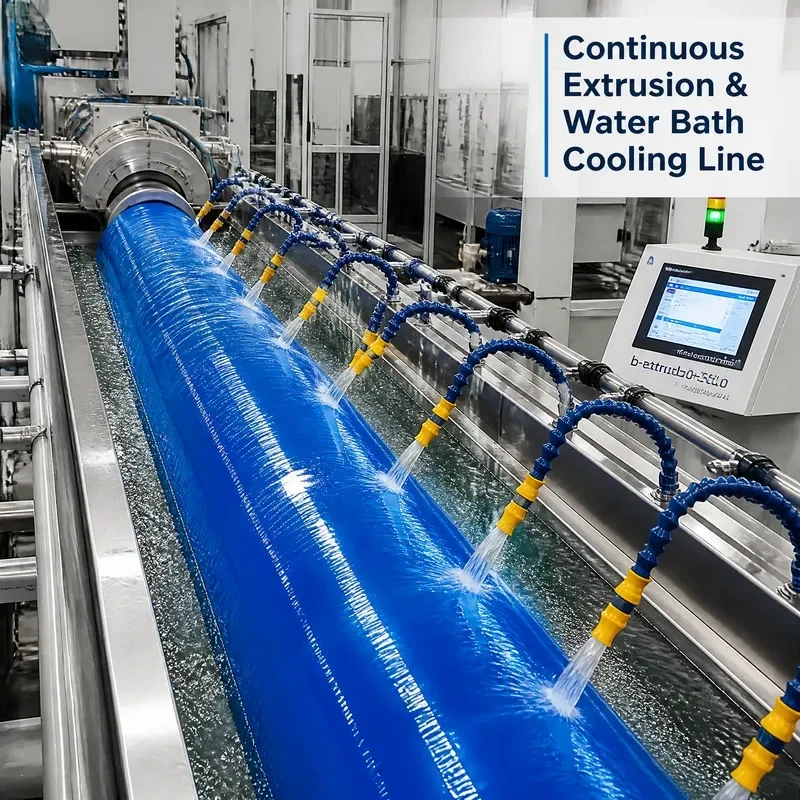
Continuous extrusion with in-line water bath cooling: yarn encapsulated in one pass, no glued seam.
Temperature, UV and Media
The working range is -5 °C to +65 °C. Below freezing the PVC stiffens, so the hose should be drained and rolled before cold weather rather than folded when rigid. Above the upper limit the wall softens and the pressure rating falls.
The cover is UV stabilised for permanent outdoor exposure and resists ozone and mild agricultural chemicals, including liquid fertiliser solutions. It is not intended for potable water schemes without local approval, nor for solvents or strong acids.
Water in the Field
The picture below shows a heavy-duty layflat line running through a leafy crop, wet from irrigation. The hose sits on the soil surface, follows the bed, and is moved between blocks as the season progresses.
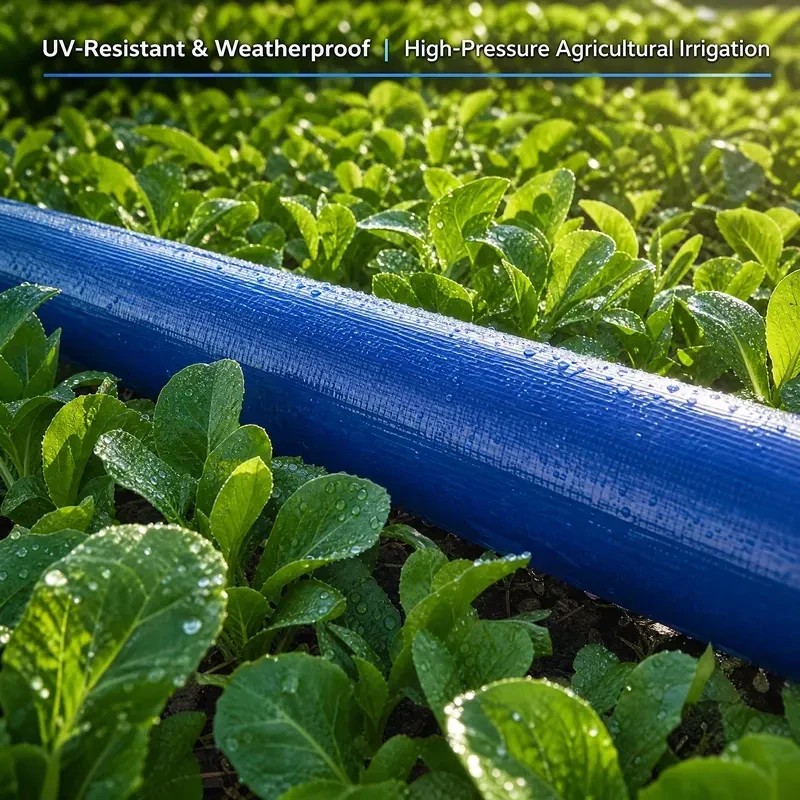
Field irrigation: the flat profile follows the bed and the UV-stabilised cover takes full sun.
Applications
Agricultural irrigation
Main delivery lines for drip manifolds, sprinkler blocks, liquid fertiliser transfer and seasonal flood irrigation, including rice paddy filling.
Civil and municipal dewatering
Groundwater discharge from foundation pits, utility trenches and tunnels, plus flood relief pumping where a long temporary line has to be laid quickly.
Mining and quarrying
Open-pit drainage, tailings dewatering, slurry transfer and wash plant water supply, where the hose is dragged over rough ground.
Submersible and trash pumps
Direct discharge lines for portable submersible pumps, centrifugal water pumps and engine-driven trash pumps. The photo below shows a diesel pump discharging through a blue layflat line into a paddy channel.
Pump discharge into a paddy channel: clamped at the pump, flat on the bank, full round under flow.
Industrial liquid transfer
Cooling water, plant effluent drainage and general water distribution where a temporary or semi-permanent line is needed.
Technical Specifications
Parameter | Specification |
|---|---|
Wall material | Virgin PVC compound, UV and ozone stabilised |
Reinforcement | High-tensile braided polyester yarn, longitudinal and helical weave |
Moulding | One-step co-extrusion, seamless bond |
Working pressure | 4 bar light, 6 bar medium, 8 to 10 bar heavy duty |
Burst pressure | About 3 times working pressure |
Temperature | -5 °C to +65 °C |
Bore sizes | 20 mm to 408 mm standard, metric and imperial |
Standard roll | 100 m, custom 50 m and 200 m lengths available |
Colours | Blue, green, red, yellow, black, orange, custom branding |
Media | Water, wastewater, slurry, liquid fertiliser, mild chemicals, non-potable |
Rolls, Packaging and Bulk Supply
A 100 m roll of layflat hose compresses into a flat coil that stacks on a pallet without crushing the wall, which is why container loads of this hose are far more compact than the equivalent pipe. Colour coding helps crews separate irrigation, dewatering and slurry lines on a site.
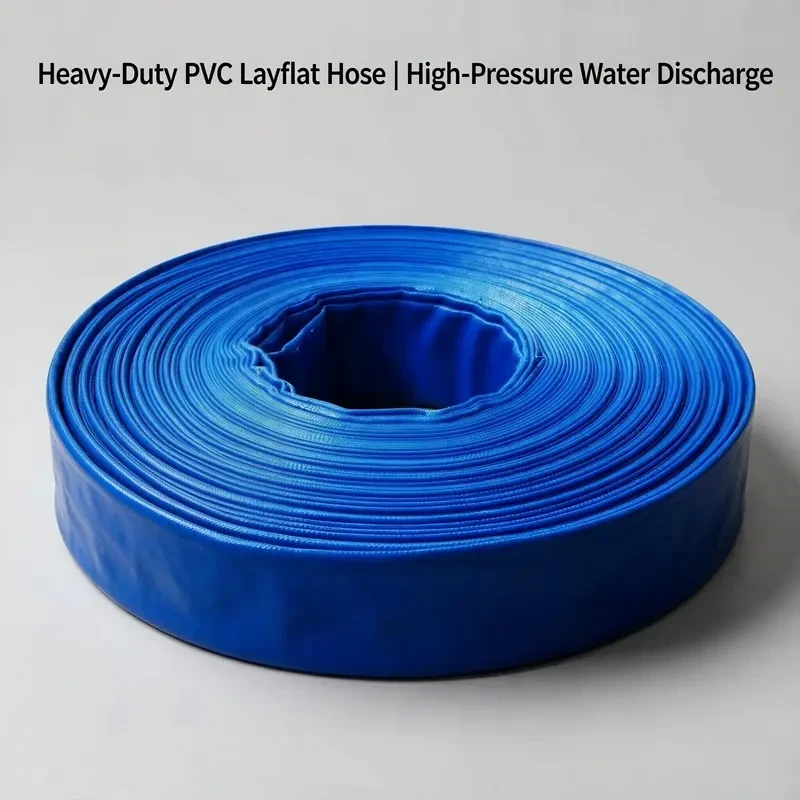
Flat coil: a 100 m roll stores and ships without the wall taking a permanent set.
Export orders are supplied as shrink-wrapped coils on pallets, stacked for bulk warehouse supply and container loading. Custom lengths, diameters, colours and print are available for OEM and distributor programmes.
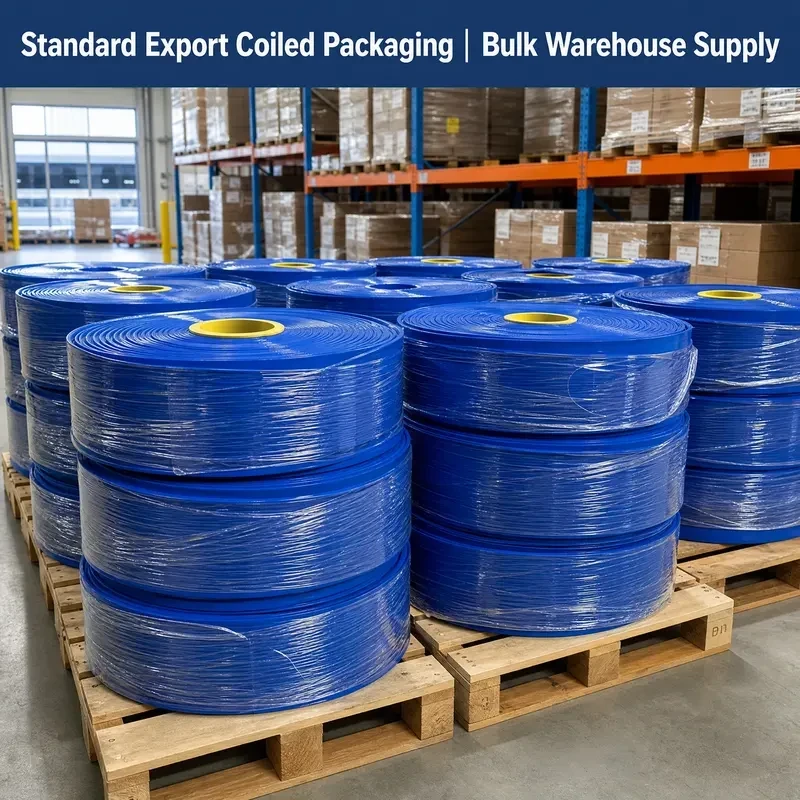
Export packaging: shrink-wrapped coils stacked on pallets for bulk supply.
Installation and Care
Match the class to the pump head. Choose 4 bar for low-head transfer, 6 bar for general irrigation and dewatering, and 8 to 10 bar for high-head or long runs.
Use the correct coupling. A hose tail or camlock sized to the bore, with a clamp that does not cut the cover.
Avoid sharp bends at the pump. A short elbow of stiffer hose protects the layflat line from the worst stress point.
Drain and dry before rolling so the wall does not trap water or grow biofilm between seasons.
Do not drag a pressurised line across sharp rock. Move the hose flat and empty.
Store out of direct sun in a dry, ventilated place, and rotate stock so older rolls are used first.
Frequently Asked Questions
What pressure classes are available?
Three: 4 bar light duty, 6 bar medium duty and 8 to 10 bar heavy duty. Burst pressure is roughly three times the working pressure.
What temperature range does it cover?
-5 °C to +65 °C. Ratings fall as the water temperature rises, so allow margin on hot discharge.
What bore sizes and roll lengths are supplied?
20 mm to 408 mm bore, supplied on 100 m rolls as standard, with 50 m and 200 m lengths on request.
Does the hose stay flat when pressurised?
No. It lies flat when empty and rounds out under flow. That is what allows compact storage and full-bore flow.
Will the inner liner separate from the cover?
The hose is made by one-step extrusion with the yarn encapsulated in a single pass, so there is no glued seam or separate liner to delaminate.
Is it suitable for drinking water?
It is intended for non-potable agricultural, construction and industrial water. Confirm local approval before any potable use.
Can it be used with a trash pump?
Yes. It is a common discharge line for engine-driven trash pumps, submersible pumps and centrifugal water pumps.
How long will a roll last?
Service life depends on pressure, sun exposure and how the hose is dragged and stored. Draining, shading and avoiding sharp bends at couplings are the three things that make the biggest difference.
Choosing the Right Hose
For temporary water transfer this hose covers most farm, civil and mine duties. The PVC braided suction and discharge hose guide covers short suction runs where a helix is needed, the flexible ducting range covers air and fume extraction, and the PVC rubber grit hose guide covers abrasive slurry. For a pressure class recommendation, a sample or a container quotation, contact the ECOOSI technical team.
Related Articles
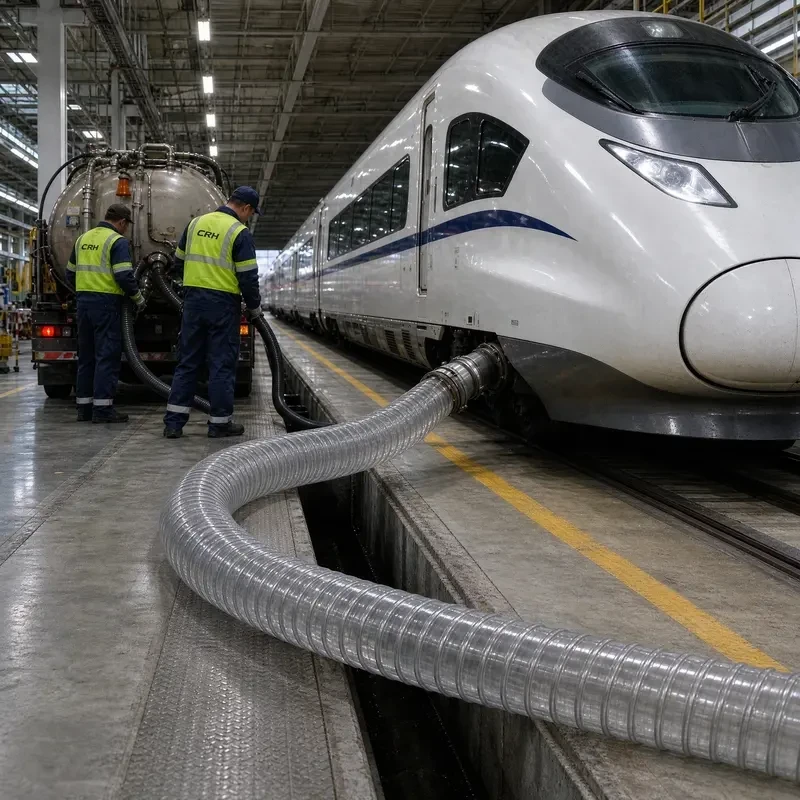
Food-Grade Ether-Based PU Hose with Stainless Steel Helix: Powder Conveying Guide
Guide to the ECOOSI ether-based food-grade PU hose with stainless steel wire helix: hydrolysis and microbe resistant wall, hose wall, smooth bore, -40 to +100 °C with peaks to +125 °C, 10 m coils for food powder conveying, pharma charging and rail vacuum sewage.
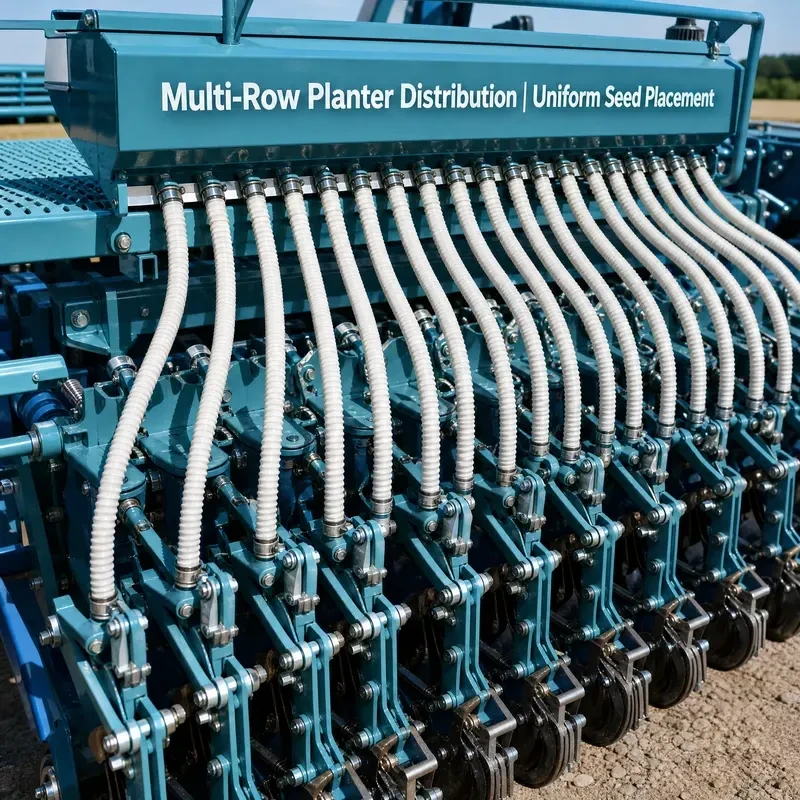
PU Seeder Hose with Rigid PVC Helix: Air-Suction Planter Delivery Guide
Guide to the ECOOSI PU seeder hose: ester-based polyurethane wall, embedded rigid PVC helix, smooth bore, -40 to +90 °C with peaks to +125 °C, 25-150 mm bore, 20 m and 30 m coils for air-suction seeders, grain drills and fertiliser lines.
PVC Rubber Grit Hose: Yellow Helix Abrasion-Resistant Suction Guide for Blasting and Duct Cleaning
Guide to the ECOOSI heavy-duty PVC and rubber compound grit hose: soft elastomer wall, rigid yellow PVC helix, mirror-smooth bore, -10 to +60 °C standard or -20 to +80 °C heavy-duty, 51-203 mm bore, 20 m coils for blasting, duct cleaning and slurry recovery.