
Clamped Double-Ply Silicone Fiberglass Duct: 400 °C High-Temperature Hose Guide
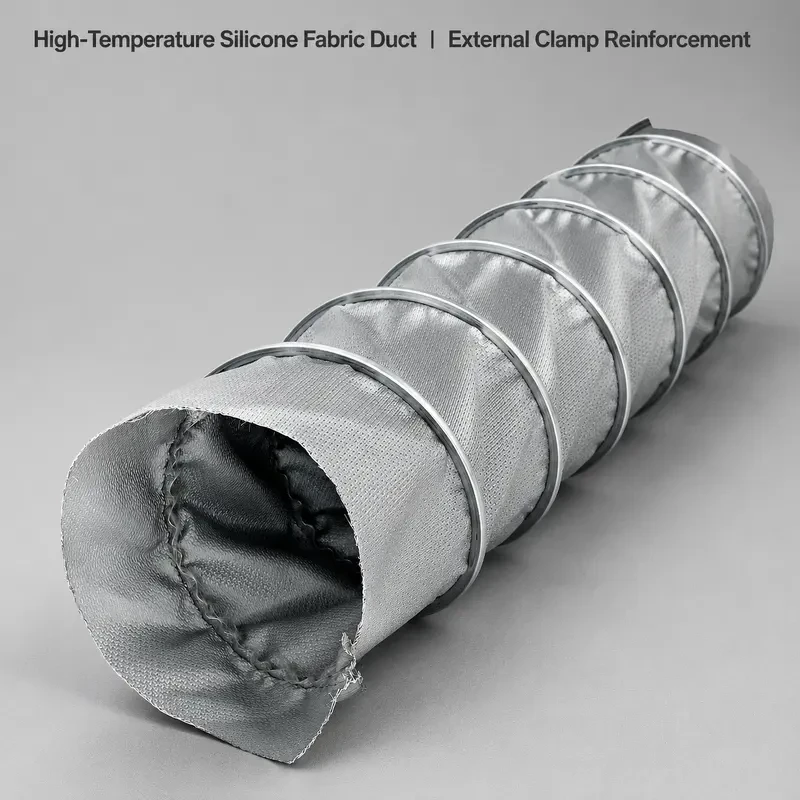
Guide to ECOOSI clamped double-ply silicone coated fiberglass high-temperature ducting: external galvanized steel clip wear strip, -80 °C to +400 °C with +450 °C peaks, 10:1 compressible, 38 to 1000 mm bore for foundry fume, kilns and dyno cells.
The ECOOSI clamped high-temperature duct is a double-ply silicone-coated fiberglass hose where the fabric is mechanically crimped around a coated steel wire by an external galvanized steel strip, rated from -80 °C to +400 °C with intermittent peaks to about +450 °C. The external clip does two jobs at once: it locks the fabric without adhesive, and it becomes the part that wears when the hose is dragged across a concrete floor.
It is supplied in 10 m pieces with a 10:1 axial compression, in bores from 38 mm to 1000 mm, for foundry fume, kiln flue gas, engine test cells and industrial hot air.
Two Problems, One Construction
A high-temperature duct in a foundry or a dyno cell usually fails for one of two reasons, and only one of them involves heat:
- Heat. The coating burns off, the fabric delaminates from the wire, and the wall goes brittle at the bends.
- Drag. The hose is pulled across concrete, grating and steel plate dozens of times a shift. On a glued duct the fabric is the wear surface, so it abrades through and the seam opens.
Most catalogue hose solves the first problem and ignores the second. Moving the wear surface from the fabric to a metal strip is what changes the service life in a real plant.
Mechanical Clamp Versus Glued Seam
| Glued or vulcanised seam | Continuous mechanical clamp | |
|---|---|---|
| Fabric to wire joint | Adhesive or vulcanised bond | Steel strip crimped over the fabric |
| Heat limit at the joint | Bond softens before the fabric does | Metal joint, no adhesive to soften |
| Drag wear | Fabric takes the abrasion | External metal strip takes the abrasion |
| Failure mode | Delamination, seam opening | Gradual strip wear |
| Field repair | Not practical | Damaged section can be cut out and rejoined |
Removing the adhesive also removes the weak point where heat and time do their work. The mechanical lock holds the fabric against the wire under negative pressure without relying on a bond that ages.
Construction
| Layer | Material | Function |
|---|---|---|
| Wear strip | External galvanized steel clip | Takes floor friction and protects the fabric wall |
| Core | Coated steel wire helix | Mechanical lock and hoop strength under negative pressure |
| Wall | Double-ply silicone-coated fiberglass | Thermal barrier, flame retardancy and chemical resistance |
| Body | 10:1 axially compressible | Compact storage, tight bends, easy routing |
Two plies matter at the top of the range. The outer ply faces the ambient air and the drag; the inner ply faces the gas. Between them the silicone coating limits heat transfer through the wall, which keeps the wire cooler than the gas and slows the oxidation that eventually kills a single-ply duct.
What 400 °C Actually Means
| Condition | Limit |
|---|---|
| Continuous gas temperature | Up to +400 °C (+752 °F) |
| Intermittent peak | About +450 °C (+842 °F) |
| Cold limit | -80 °C (-112 °F), stays flexible |
| Not intended for | Direct flame impingement, molten metal splash, continuous operation above the peak |
The rating applies to the gas stream, not to a hot surface parked against the wall. A duct that is laid on a hot manifold or left with its end against a burner will fail well below its rated temperature, because that is conductive heat, not convective.
Peaks are short by definition. If the process runs above 400 °C for minutes at a time, the duct is the wrong component; a high-silica or metal duct is the right answer.
Compression and Handling
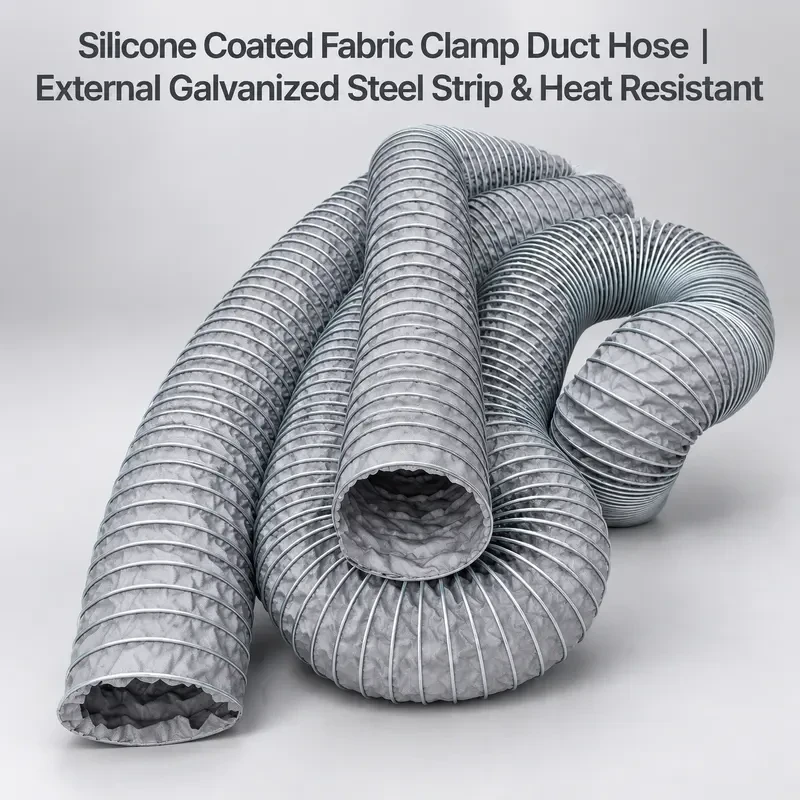
A 10:1 ratio means a 10 m length packs to roughly 1 m. On a large bore, that is the difference between a manageable carton and a crate, and it is why these ducts ship economically even at 1000 mm diameter.
Compression also helps installation in a tight bay: the duct can be pushed short to fit between two fixed points and then extended to take up the gap. Do not use compression as a substitute for a proper support, though, because a compressed wall carries less hoop strength.
Bores from 38 mm to 1000 mm
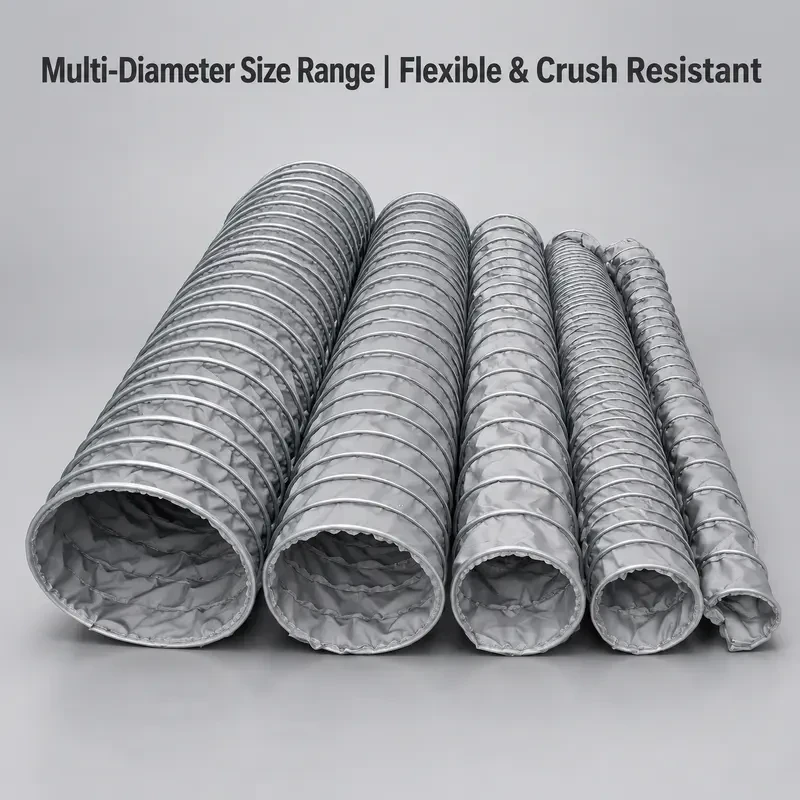
Small bores suit engine bay and defroster lines where the run has to turn tightly. Large bores suit kiln flue gas and foundry extraction, where velocity matters more than bend radius and the duct is supported along its length.
Size for the volume flow at the working temperature, remembering that hot gas expands: a duct sized on cold volumetric flow will run at higher velocity and higher pressure drop once the gas is hot.
Dragging and Floor Contact
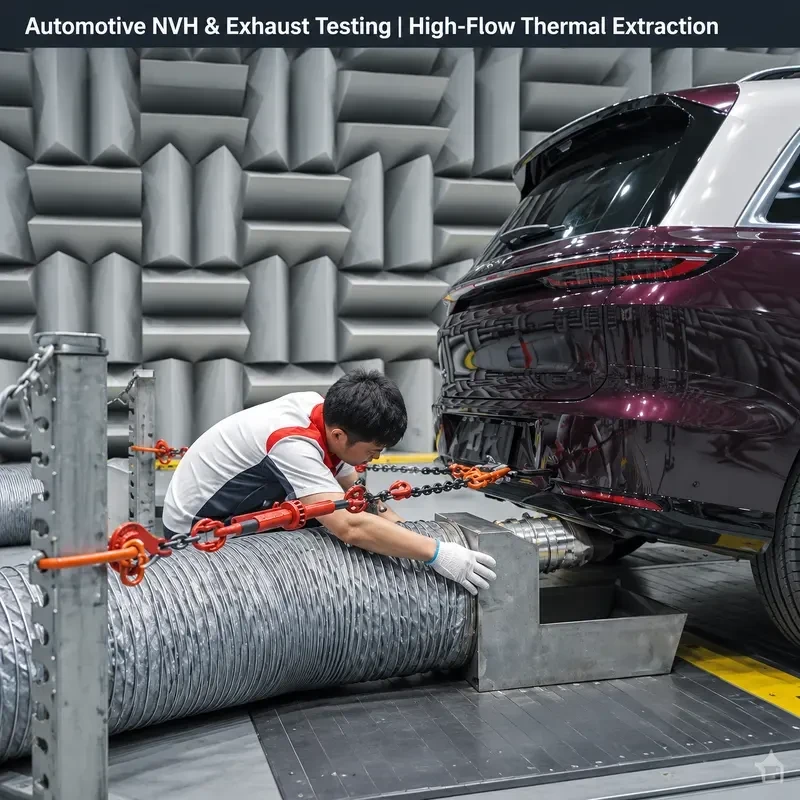
This is the detail that decides service life in a workshop. The hose is pulled into position by hand, dragged over a lip, and left lying on a tiled or grated floor while the vehicle runs. With the clip on the outside, the silicone never touches the ground, so the wall keeps its coating and the seam keeps its lock.
It also makes the duct easier to move: a metal ridge slides on concrete where a fabric wall grabs and tears.
Engine Test Cells and Dyno Rooms
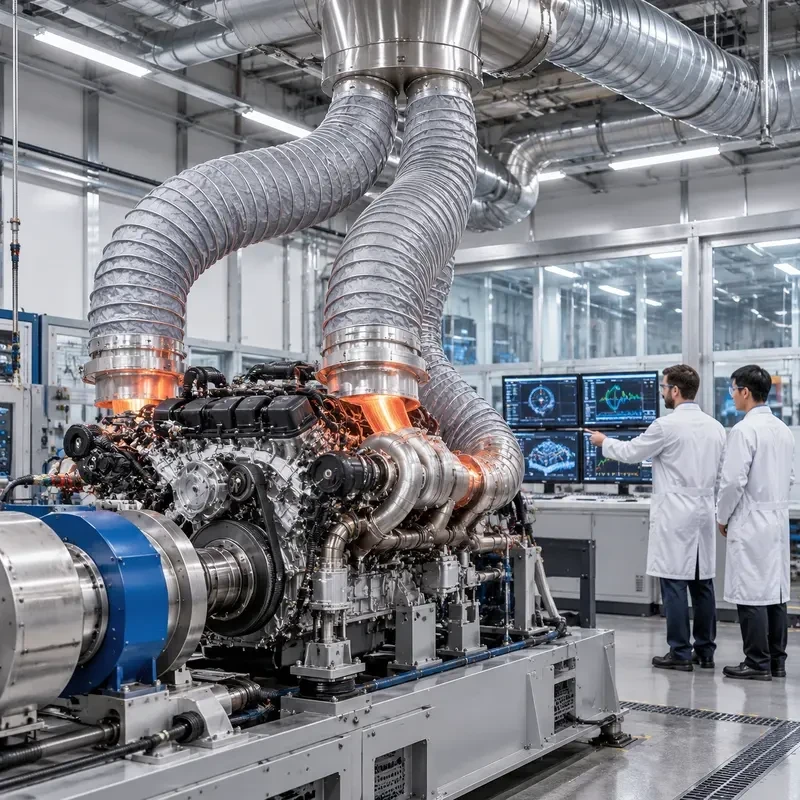
On a test bench the duct takes exhaust at the manifold or turbo outlet, absorbs engine movement through the ribs, and carries the gas to the extraction main. The compressible body also lets the same duct fit different engine bay layouts without a new part number for every programme.
Specifications
| Parameter | Specification |
|---|---|
| Series | Clamped high-temperature profile duct, heavy-duty grade |
| Wall | Double-ply silicone-coated fiberglass fabric |
| Reinforcement | Coated steel wire helix with external galvanized steel clip, continuous mechanical crimp |
| Temperature | -80 °C to +400 °C, peak about +450 °C |
| Flame | Flame-retardant composite, self-extinguishing |
| Compression | About 10:1 axial |
| Standard length | 10 m per piece, custom continuous lengths available |
| Bore | 38 mm to 1000 mm (1.5 to 40 inch) |
| Media | Hot and cold gas, smoke, furnace fume, vehicle exhaust, dust, fibre |
Applications
Smelting and heavy metallurgy
Blast furnace, aluminium mill, steel plant, smelting furnace and foundry fume extraction.
Ceramics and glass
Kiln flue gas venting, glass annealing oven exhaust and high-temperature drying tunnels.
Automotive and engine testing
Engine test benches, diesel exhaust systems, garage exhaust reels, heater and defroster lines, chassis dynamometers.
Aircraft ground support
High-temperature air delivery, cabin defroster ducts and ground engine ventilation.
Industrial hot air and fume control
Ovens, industrial heaters, chemical vapour extraction and high-temperature dust or fibre collection.
Customisation
Bores from 38 mm to 1000 mm, non-standard cut lengths, private labelling and special colours are available. For OEM programmes, send the gas temperature, flow, bore and the routing envelope so the clip pitch and wall build can be confirmed together.
Installation and Care
- Support large bores at intervals along the run; the clip profile is not a structural beam.
- Keep the duct off hot surfaces; conductive contact fails the wall below its gas rating.
- Leave the clip in contact with the floor when dragging, not the fabric end.
- Do not compress a hot duct; let it cool before packing it down.
- Inspect the clip for flattening or corrosion at each strip; a worn strip is the first sign of drag damage.
- Store dry and compressed in a carton, away from oil and sharp edges.
Frequently Asked Questions
What temperature can the duct handle?
Up to +400 °C continuous, with intermittent peaks to about +450 °C, and down to -80 °C without losing flexibility.
What is the clamp profile for?
The external galvanized steel strip mechanically locks the fabric to the wire and takes floor friction, so the silicone wall is not the wear surface.
Why is mechanical clamping better than a glued seam?
There is no adhesive to soften at temperature or to fail with age, and drag wear lands on the metal rather than the fabric.
How much does it compress?
About 10:1, so a 10 m length packs to roughly 1 m for transport and storage.
What is the largest bore available?
1000 mm (40 inch) in the standard range, with custom diameters on request.
Can it vent engine exhaust directly?
Yes, on test benches and garage extraction within the temperature rating. It is not for direct flame contact or molten splash.
Is it flame retardant?
The construction is a self-extinguishing flame-retardant composite. Confirm the requirement for your installation and ask for the current report.
Do you supply custom lengths and markings?
Yes. Custom lengths, diameters, colours and private labelling are available for volume orders.
Next Step
For the wider family see the high-temperature ducting range, for the 800 °C class the high-silica fiberglass guide, and for garage tailpipe extraction the EPDM crush-proof exhaust hose guide. Send your gas temperature, flow rate and bore to the ECOOSI technical team for a duct selection.
Related Articles
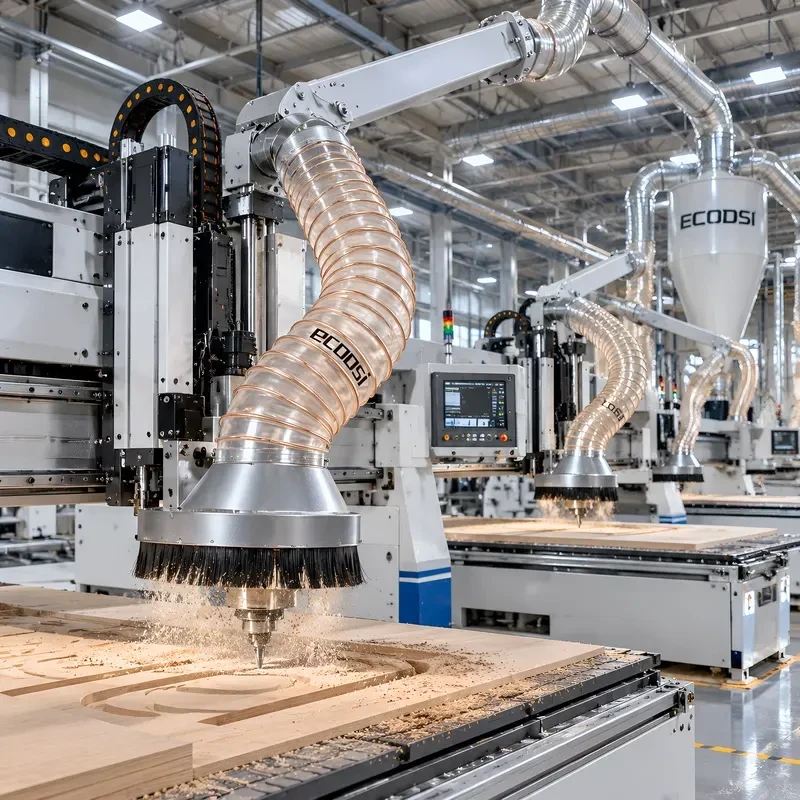
Antistatic PU Woodworking Dust Collection Hose: CNC and Sawdust Extraction Guide
Guide to ECOOSI antistatic PU woodworking dust collection hose: copper wire helix, flame-retardant abrasion-resistant polyurethane, -40 °C to +90 °C with +125 °C peaks, 4:1 compressible, for CNC routers, panel saws and sawdust extraction.
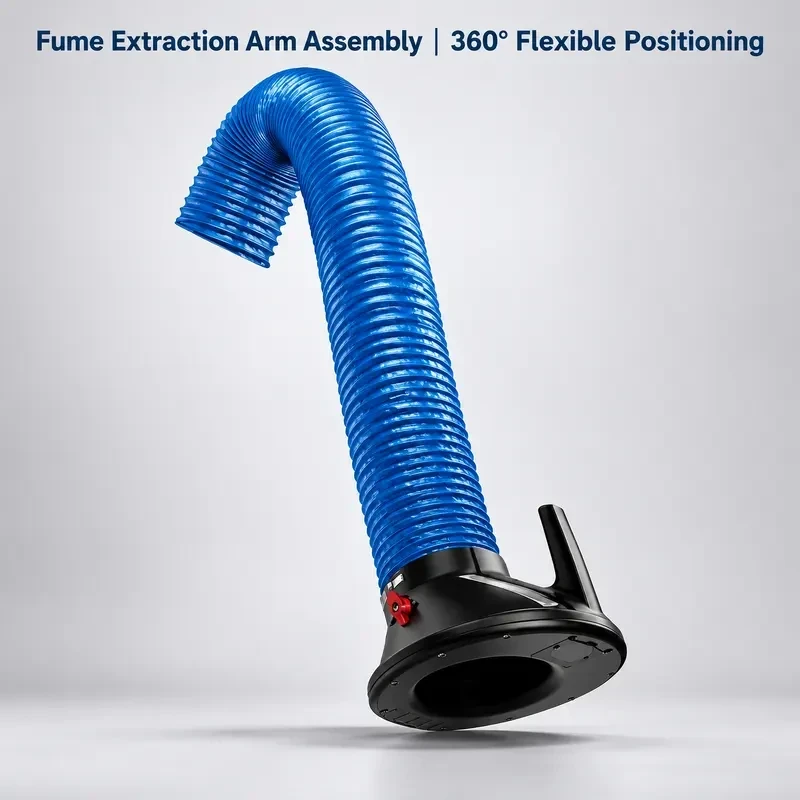
Super-Light PVC Coated Fabric Fume Extraction Hose: 10:1 Compressible Welding Duct Guide
Guide to ECOOSI super-light PVC coated fabric fume extraction hose: 0.35 mm wall, 10:1 axial compression, spring steel helix with static grounding, -10 °C to +80 °C with +100 °C peaks, 38 to 406 mm bore for welding fume arms and light dust collection.
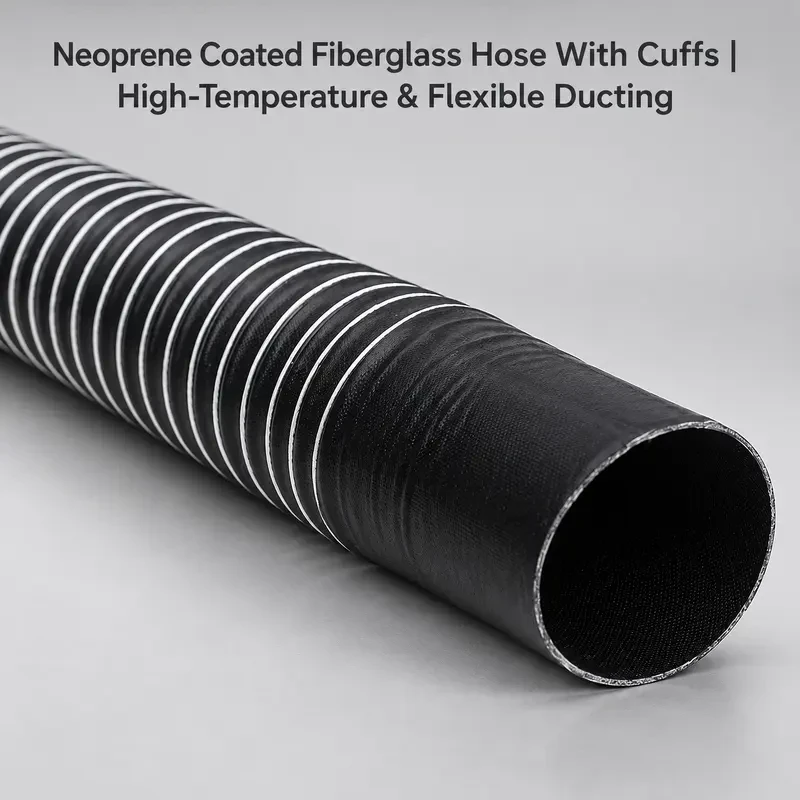
Neoprene Air Intake Hose for New Energy Vehicles: Wire-Reinforced EV Duct Guide
Guide to ECOOSI black neoprene air intake hose for NEV and EV platforms: spring steel wire helix, corrugated body for vibration isolation, -40 °C to +135 °C with +150 °C peaks, 38 to 203 mm bore for air cleaners, battery pack cooling and motor cooling ducts.