
Super-Light PVC Coated Fabric Fume Extraction Hose: 10:1 Compressible Welding Duct Guide
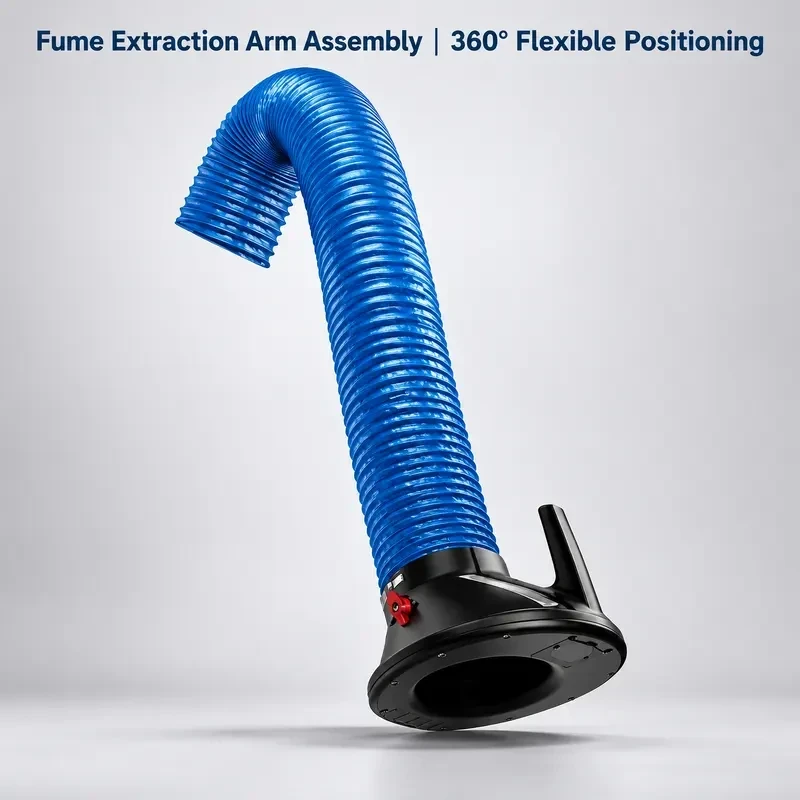
Guide to ECOOSI super-light PVC coated fabric fume extraction hose: 0.35 mm wall, 10:1 axial compression, spring steel helix with static grounding, -10 °C to +80 °C with +100 °C peaks, 38 to 406 mm bore for welding fume arms and light dust collection.
The ECOOSI fume extraction hose is a PVC-coated reinforced fabric duct with an integrated spring steel wire, an ultra-thin wall of about 0.35 mm and a 10:1 axial compression ratio, rated from -10 °C to +80 °C with short-term peaks to +100 °C. It is supplied in bores from 38 mm to 406 mm in grey, black or blue, for welding fume arms, mobile filter units and light dust extraction.
The design brief is simple: make the duct light enough that an operator can move an extraction arm with one hand, and pack it small enough that a container carries more metres than a rigid hose would allow.
Why Weight and Compression Decide the Purchase
Three costs sit behind that brief, and none of them appear on a data sheet:
- Freight volume. A duct that does not compress ships air. A 10:1 hose turns a 10 m length into roughly 1 m of packed coil, which changes the container maths on an export order.
- Operator fatigue. Every extra gram at the end of an arm is a gram the operator lifts all shift. A heavy duct turns a 360-degree arm into a two-handed tool.
- Storage and changeover. Mobile filter carts and temporary extraction points need a duct that folds away, not one that has to be hung on a wall.
Construction
| Layer | Material | Function |
|---|---|---|
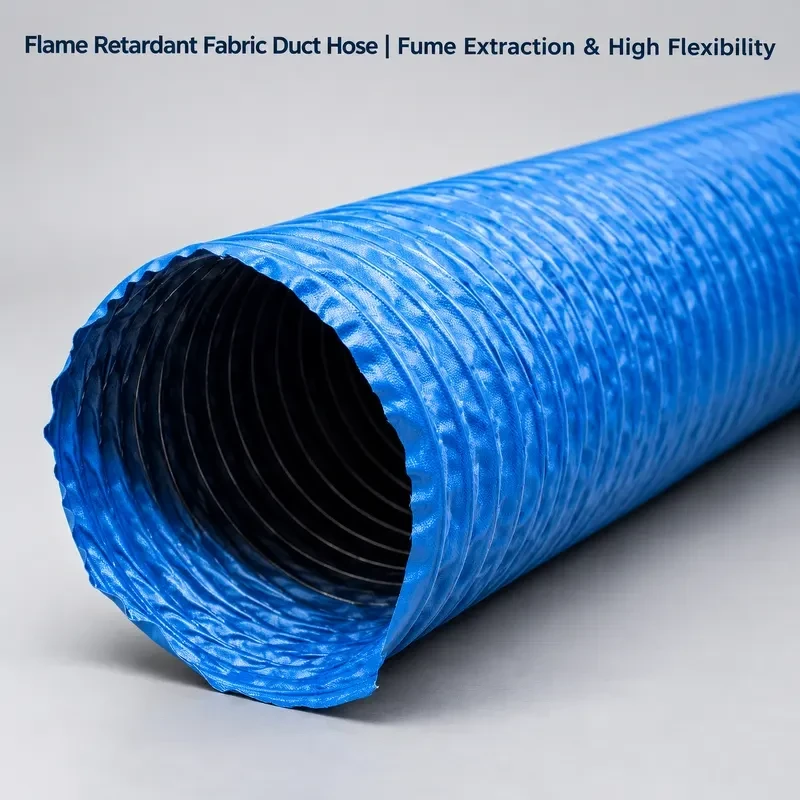
| Wall | PVC-coated reinforced fabric, about 0.35 mm | Acid, alkali, UV and ozone resistance with low weight |
| Reinforcement | Integrated spring steel wire helix | Anti-collapse support and static grounding path |
| Wall reinforcement | Woven fabric base | Tear and abrasion strength in a thin section |
| Body | Axially compressible, 10:1 | Compact transport, tight bend radius, overhead routing |
What 10:1 Compression Means in Practice
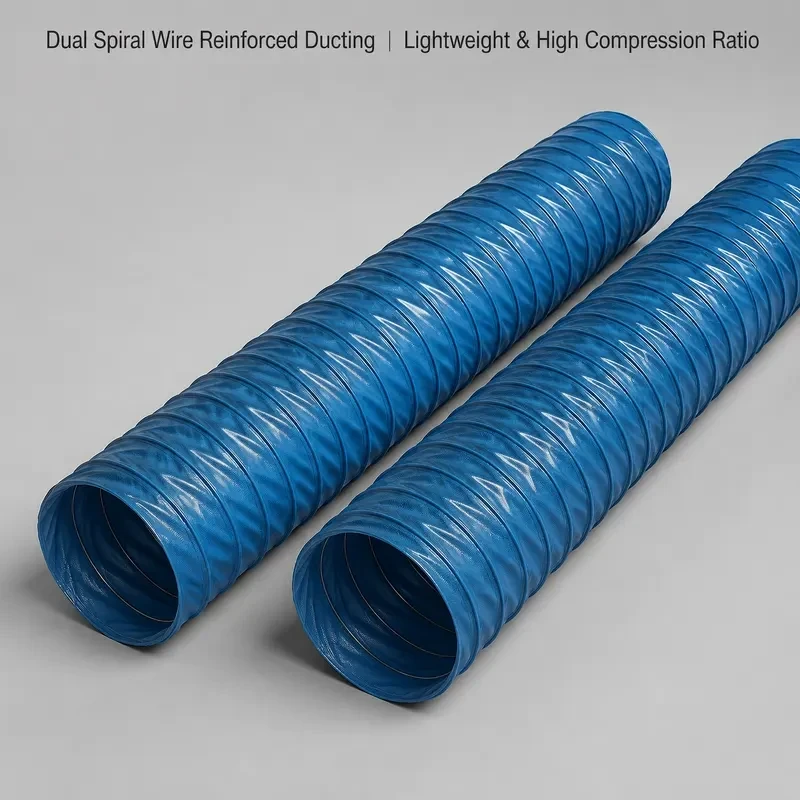
A 10:1 ratio means the duct can be pushed down to about one tenth of its working length. A 10 m run packs into roughly 1 m of coil; a 20 m run into about 2 m. On an export order that is the difference between paying for hose and paying for air.
Compression also helps on site. Ducts arrive folded in a carton, then extend along the arm as it is installed, which is why mobile filter units and temporary bays can be set up without a scaffold.
Two practical cautions. Store the duct compressed rather than hanging under its own weight for months, and do not compress it while it is still warm from welding fume, because the wall forms a set more readily at the top of its range.
Thin Wall, Real Strength
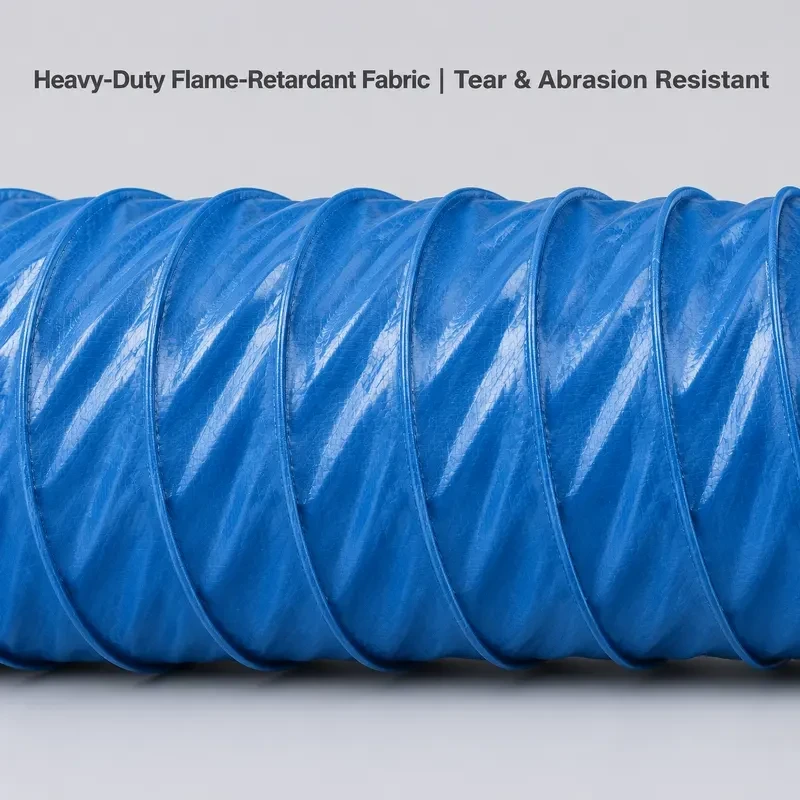
The wall is a composite, not a film. The woven base takes the tear load and the PVC coating seals it against acid vapour, alkaline condensate and flux fumes. That is why a 0.35 mm wall survives being dragged across a welding bench when a plain plastic film would split at the first nick.
It also keeps the duct light enough for an extraction arm to stay where it is put. A duct that sags under its own weight will not hold position over a weld pool.
Flame Rating and Static Grounding
Welding fume includes sparks, spatter and hot smoke, so the wall is formulated as a flame-retardant, self-extinguishing compound to the UL94 VTM-0 class for thin materials. Flame acceptance is a system question: the duct, hood, fan and mounting all matter. Ask us for the current test report and confirm it against the requirement for your installation rather than relying on a catalogue line.
The spring steel helix can carry static to earth when it is bonded to the end fitting and the fitting is grounded. That is how a fabric duct avoids the charge build-up that makes dust cling to the wall and can produce a spark in a solvent vapour stream. Treat the helix as part of an earthing design, not as a complete one: check continuity at both ends and confirm the whole extraction system is bonded for the hazard present.
Temperature and Limits
| Parameter | Rating |
|---|---|
| Continuous working temperature | About -10 °C to +80 °C (14 °F to +176 °F) |
| Short-term peak | About +100 °C (+212 °F) |
| Cold behaviour | Coating stays pliable at the low end of the range |
| Not suitable for | Hot exhaust gas, oven flue, molten spatter contact |
This is a fume and ventilation duct, not a hot-gas exhaust duct. A welding arc radiates heat but the captured fume at the hood is normally within the range; the wall fails when the hood is parked against a hot workpiece or when exhaust gas from an engine or oven is routed through it. For those duties use an EPDM exhaust hose or a high-temperature duct.
Sizes and Airflow
Standard bores run from 38 mm to 406 mm (1.5 to 16 inch), which covers everything from a single soldering bench hood to a shop-wide extraction main. Size the duct by airflow and transport velocity, not by the hood diameter alone: too small a bore raises static pressure and starves the hood, too large a bore drops the transport velocity in a dust line and lets material settle.
On an Extraction Arm
On an articulated arm the duct is the muscle and the joint is the brake. A light duct with a tight bending radius lets a 3 m or 4 m arm reach across a bench and stay put, and it lets the operator reposition the hood with one hand between welds.
Where It Is Used
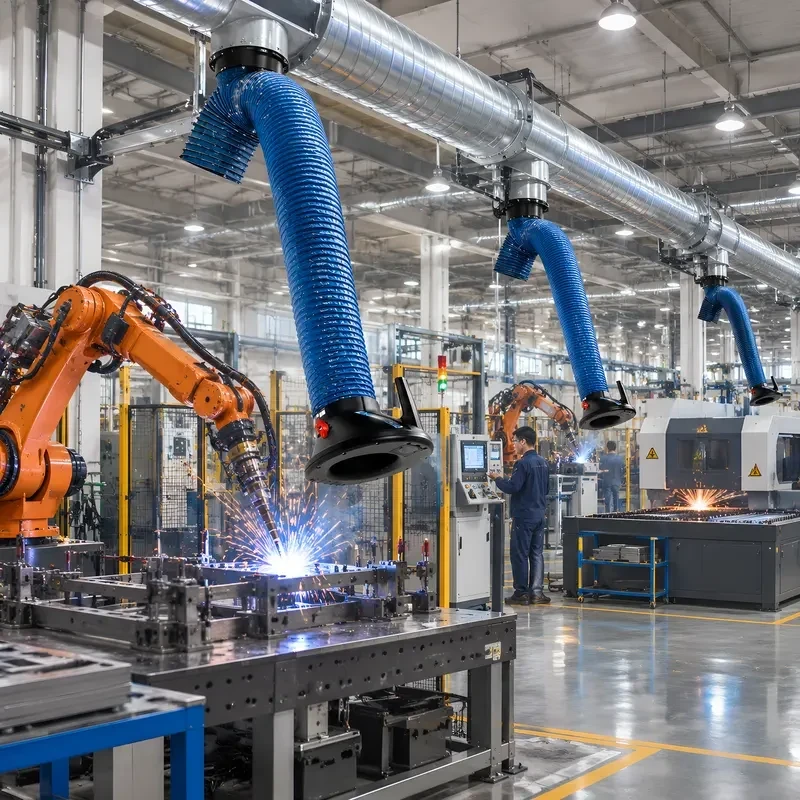
Welding and soldering fume extraction
Manual welding, robotic welding cells, soldering benches and laser cutting exhaust.
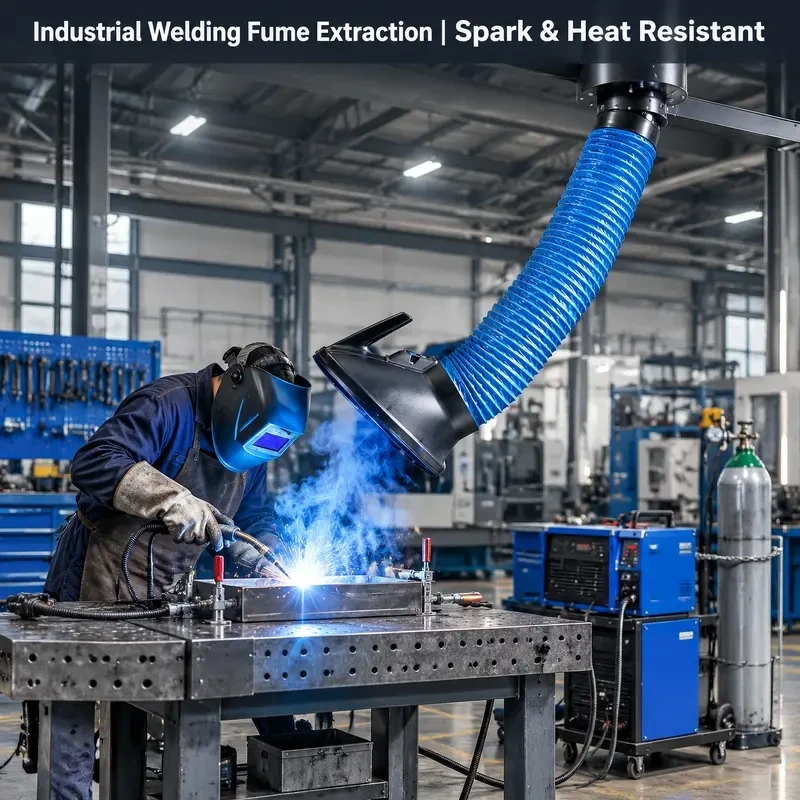
HVAC and workshop ventilation
Air distribution, fresh air intake, stale air exhaust and light-duty air movement in industrial buildings.
Light dust collection
Lint, textile fibre, plastic dust and packaging debris where the load is light and the duct is not an abrasive slurry line.
Articulated arms and mobile units
Wall-mounted swing arms, ceiling drops and portable filter carts that are moved between bays.
Specifications
| Parameter | Specification |
|---|---|
| Series | Super-light fume exhaust hose, industrial extraction grade |
| Wall | PVC-coated reinforced fabric, about 0.35 mm |
| Reinforcement | Integrated spring steel wire, encapsulated in the wall |
| Flame | UL94 VTM-0 class flame-retardant compound, report on request |
| Compression | 10:1 axial |
| Temperature | About -10 °C to +80 °C, peak about +100 °C |
| Bore | 38 mm to 406 mm (1.5 to 16 inch) |
| Colours | Grey, black, blue; custom colours on request |
| Media | Alkalis, acids, chemical vapour, UV, ozone, light dust |
Customisation
Diameters up to 406 mm, custom continuous lengths, colour matching for bay identification, and private labelling with customer markings are available. For OEM orders, send the bore, length, colour and marking artwork with your annual volume so the packing format can be planned at the same time.
Installation and Care
- Support the duct at intervals so a horizontal run does not sag between hangers.
- Keep the hood clear of the arc and of hot workpiece surfaces; fume is cool, spatter is not.
- Bond the helix at both ends where static is a hazard, and check continuity after every re-installation.
- Do not over-compress a warm duct; let it cool before packing it down.
- Wipe or wash the wall on dust duty so the coating does not hold a static-clinging layer.
- Store compressed, dry and out of sunlight, and check the wire ends for corrosion before reuse.
Frequently Asked Questions
What does 10:1 compression mean?
The duct can be compressed to about one tenth of its working length, so a 10 m run packs into roughly 1 m of coil.
What temperature can it handle?
About -10 °C to +80 °C continuous, with short-term peaks to about +100 °C.
Is it flame retardant?
The wall is a self-extinguishing compound to the UL94 VTM-0 class. Confirm the current report against your installation requirement.
Can the wire be grounded?
Yes. The helix provides a path to earth when bonded at the end fittings, but the whole system needs to be bonded for the hazard present.
Can it be used for welding exhaust gas?
It is a fume and ventilation duct. For engine or oven exhaust, use an EPDM or high-temperature duct rated for that gas temperature.
Which diameter do I need?
Size by airflow and static pressure at the hood. Standard bores run from 38 mm to 406 mm.
Does it resist acid and alkali fumes?
Yes. The PVC coating resists acidic vapour, alkaline condensate, chemical gases, UV and ozone at the rated temperature.
Can I get custom colours and branding?
Yes. Grey, black and blue are standard; custom colours, lengths and private labelling are available for volume orders.
Next Step
For the wider family see the fabric ducting range, for arm geometry the articulated extraction arm guide, and for higher chemical and temperature demand the PTFE coated fiberglass hose guide. Send your hood airflow, duct length and fume type to the ECOOSI technical team for a size and arm recommendation.
Related Articles
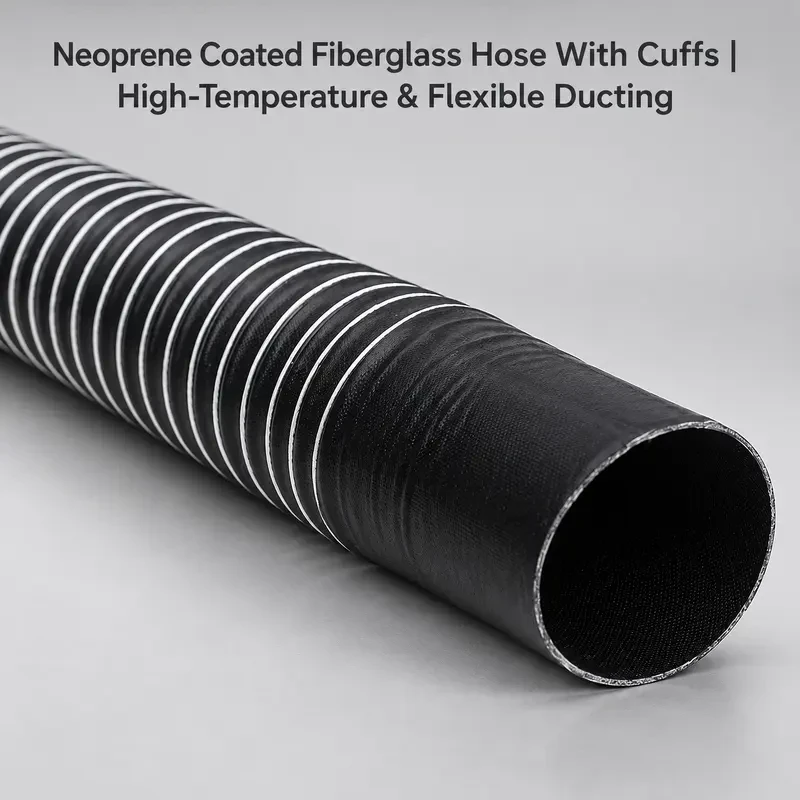
Neoprene Air Intake Hose for New Energy Vehicles: Wire-Reinforced EV Duct Guide
Guide to ECOOSI black neoprene air intake hose for NEV and EV platforms: spring steel wire helix, corrugated body for vibration isolation, -40 °C to +135 °C with +150 °C peaks, 38 to 203 mm bore for air cleaners, battery pack cooling and motor cooling ducts.
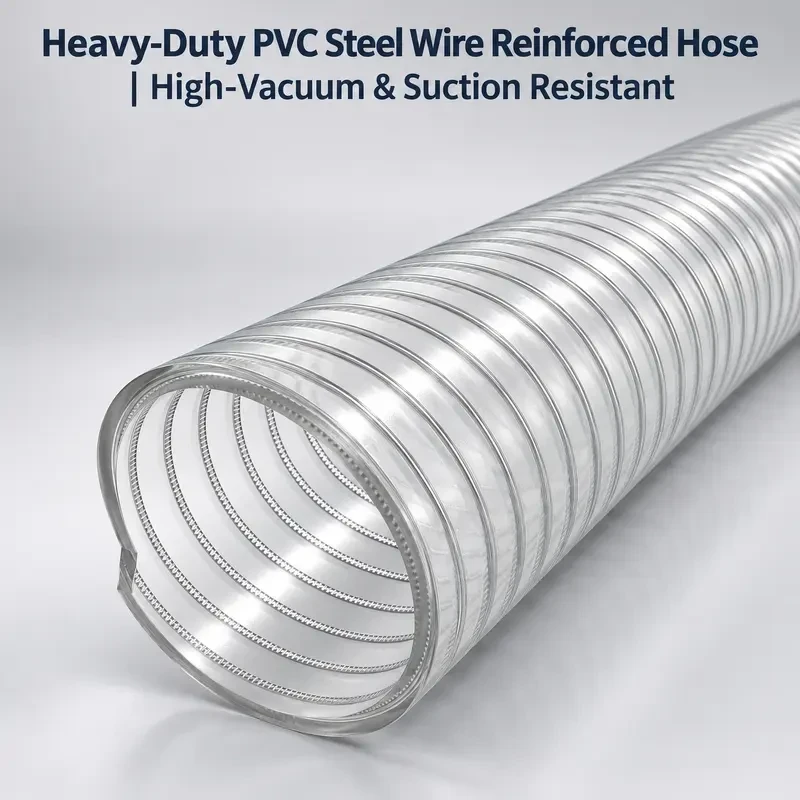
PVC Steel Wire Thunder Hose: High-Vacuum Suction and Delivery Hose Guide
Guide to ECOOSI PVC steel wire thunder hose: transparent wall with an embedded spring steel helix, dual rated for vacuum and pressure, -20 °C to +70 °C, 20 m rolls, for oil depots, agricultural pumps, mining dewatering and pneumatic conveying.
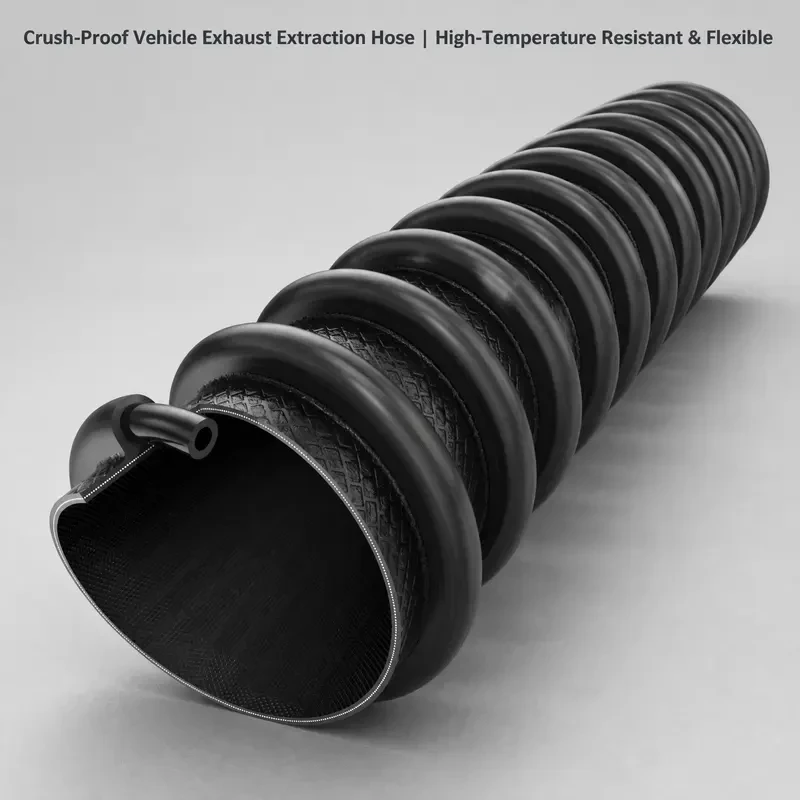
EPDM Rubber Exhaust Hose with Crush-Proof Plastic Helix: Garage Fume Extraction Guide
Guide to ECOOSI heavy-duty EPDM exhaust extraction hose: crush-resistant thermoplastic helix that recovers after drive-over, -40 °C to +150 °C with +180 °C peaks, 51 to 203 mm bore, 10 m rolls for hose reels, underfloor channels and dyno cells.